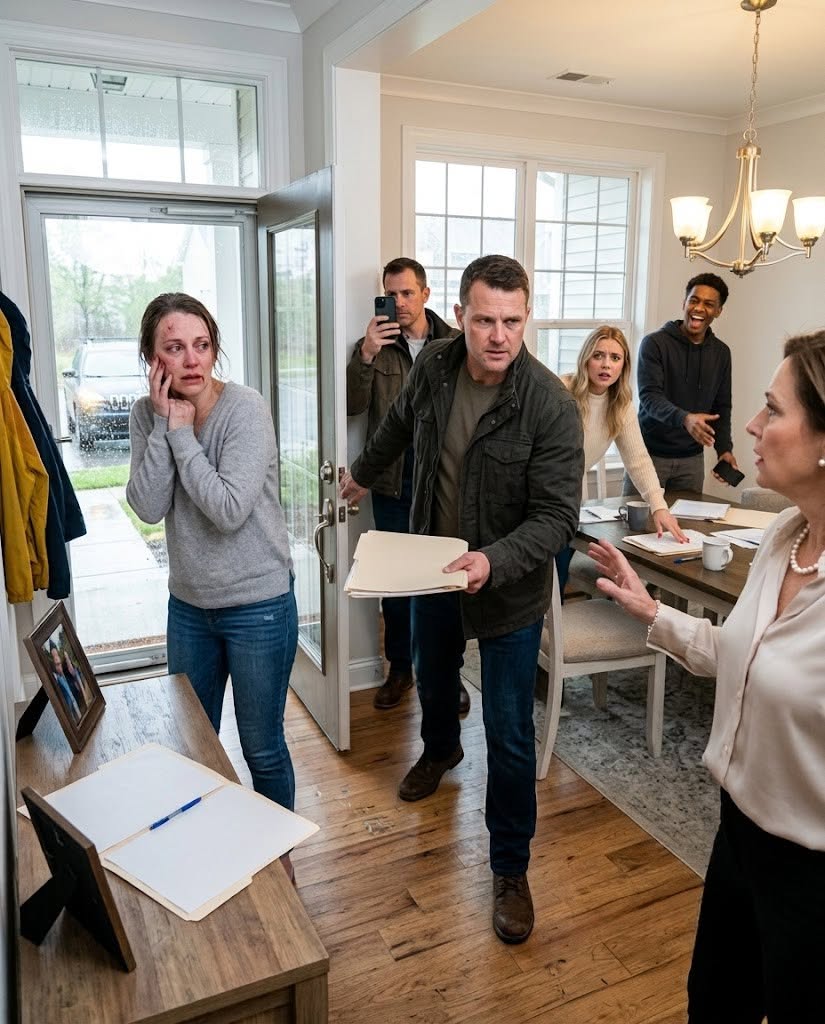
My mother struck me so hard I hit the wall.
For one second, the whole house seemed to ring from it.
Not just my face.

The hallway.
The framed photo beside the coat closet.
The chandelier over the dining room table.
Even the little brass key tray on the console table shivered like the house itself had flinched.
The taste of blood spread under my tongue, warm and metallic, and I could smell burned coffee from the pot I had forgotten to turn off before they showed up.
Rain tapped at the windows.
The small American flag on our porch snapped softly in the wind.
Inside, my family stood under my roof and looked at me like I was the one who had crossed a line.
My mother, Gloria, stood in front of me with her pearl necklace perfectly centered against her silk blouse.
She was breathing hard, but not like a person who regretted what she had done.
She looked righteous.
That was the part that scared me most.
Beside her, my sister-in-law, Tessa, leaned close and spat near my shoes.
Not on me.
Near me.
Like even that much contact would have been too generous.
From the living room sofa, Marcus laughed.
He had one ankle crossed over his knee, his phone loose in his hand, as casual as a man watching a game on a Sunday afternoon.
“Gold digger,” he said.
His voice had that lazy edge people use when they think the room belongs to them.
“Daniel is overseas, sweetheart. Nobody’s coming to save you.”
My lip throbbed.
My shoulder ached where it had hit the wall.
I could feel the bruise already forming beneath the skin, hot and deep, and I knew exactly where my mother’s ring had caught me.
Gloria’s eyes narrowed.
“You married him for his military benefits,” she said.
She stepped closer, slow enough to make it feel deliberate.
“For his pension. For this house.”
This house.
The word landed harder than the slap.
I had put the down payment on this house eighteen months before Daniel and I ever signed a marriage license.
I had sanded the kitchen cabinets until my wrists hurt.
I had painted the upstairs hallway twice because the first shade looked gray in winter light.
I had refinanced when the old furnace went out and repaired the back deck after a storm tore half the railing loose.
Daniel had been training out of state through most of it, calling me at night from cheap hotels and base housing, listening while I complained about paint fumes and bad contractors.
Everyone told me I was lucky he let me live so comfortably.
Daniel never did.
One night, we had eaten takeout on the floor beside a half-built kitchen island because there were no chairs in the house yet.
Drywall dust was on my cheek.
My hair smelled like primer.
Daniel reached across the cartons, touched the dust with his thumb, and said, “You were my home before any of this.”
That was why he insisted the house stay in my name.
Not because he did not trust me.
Because he did.
I did not say any of that to Gloria.
Not then.
My phone vibrated once in the back pocket of my jeans, but I kept my hands at my sides.
Tessa folded her arms.
Her glossy red nails dug into the sleeves of her cream sweater, and she looked me up and down like my bruised cheek was proof of something she had always suspected.
“Daniel should’ve married someone from our level,” she said.
Her mouth twisted on the word level.
“Not some quiet little office mouse who smiles and signs papers.”
That almost made me laugh.
Quiet little office mouse.
For six years, I had worked as a forensic financial investigator.
Companies called me when money disappeared and the people in charge wanted answers before a police report became public.
I knew shell accounts.
I knew forged signatures.
I knew duplicate invoices, fake vendors, routed payments, and family lies hidden under friendly language.
I knew what people did when they believed nobody careful was watching.
For three months, I had been watching my own family.
The first red flag came on a Tuesday at 9:14 p.m.
Daniel’s deployment account showed a withdrawal he had not authorized.
At first, I thought it was an error.
Military families live inside delays and crossed wires often enough that your first instinct is not betrayal.
Your first instinct is to refresh the screen.
Then I saw the second withdrawal.
Nine days later, it appeared inside a wire transfer ledger, buried under a routing memo that used Gloria’s maiden name.
That was when my stomach went still.
Not dropped.
Not clenched.
Still.
Stillness is what happens when your heart understands the truth before your mind gives it permission.
I pulled the county clerk property file first.
Then the bank authorization packet.
Then the vendor documents tied to Daniel’s veterans charity.
I reviewed signatures, timestamps, routing notes, duplicate invoices, and the strange little gaps people leave when they think fraud is only fraud if someone poor does it.
By the time I printed the first packet, I was no longer suspicious.
I was documenting.
There is a difference between panic and proof.
Panic shakes.
Proof waits.
Gloria had drained Daniel’s deployment account twice.
Marcus had used Daniel’s military ID number to secure a business loan that was never supposed to exist.
Tessa had been forging my name on vendor documents connected to a charity Daniel funded for veterans who came home with bills, scars, and nowhere decent to turn.
The charity mattered to him.
It was not some tax line or social project he mentioned at dinner to sound generous.
Daniel had sat at our kitchen table with a paper coffee cup in one hand and a notebook in the other, writing down ideas for rent grants, utility help, temporary hotel stays, and emergency grocery cards.
He knew what it meant to come home and not feel home yet.
He had seen good men go quiet after deployment.
He had seen marriages fail under bills nobody wanted to open.
He wanted the charity to be something practical.
Not speeches.
Not applause.
A check when the lights were about to be cut off.
A warm room when a couch was no longer available.
A person answering the phone.
I had helped with the first budget sheet.
Tessa had brought cupcakes to the first family fundraiser and called me “the organized one.”
Marcus had clapped Daniel on the back and said, “Man, this is the kind of thing that makes people respect a family name.”
Gloria had cried into a napkin and told everybody her son had always had a servant’s heart.
That was the thing about people like Gloria.
They loved goodness when they could stand near it.
They loved generosity when it made them look connected to it.
But the moment goodness required honesty, they treated it like an inconvenience.
For three months, I collected everything.
I saved the bank screenshots.
I downloaded the wire transfer ledger.
I printed the county clerk file and the bank authorization packet.
I made copies of the vendor documents Tessa had touched and marked the initials she had forged beside my real signature from older forms.
I kept one binder in the laundry room behind a box of dryer sheets because nobody in Daniel’s family ever looked where work was done.
Then I called Daniel.
It was 1:12 a.m. for him when he answered.
His voice was rough with sleep and distance.
At first, I could barely speak.
Not because I was unsure.
Because I knew what this would cost him.
It is one thing to discover that your money has been touched.
It is another to discover that your mother held the door open while your brother walked in.
Daniel did not interrupt me.
He listened while I walked him through every document, every timestamp, every packet number, every place where a signature should have matched and did not.
When I finished, the line stayed quiet so long I thought the call had dropped.
Then he said, “Send everything to me twice. Once to my personal email. Once to the secure drive.”
His voice had changed.
It was still Daniel.
But the softness had moved behind something colder.
“Do not confront them alone,” he said.
“I won’t.”
I meant it when I said it.
Then Gloria called.
She said she wanted to stop by with Marcus and Tessa to “clear the air.”
That was her phrase.
Clear the air.
People say that when they have already decided which windows to lock.
I should have said no.
I knew that before I opened the door.
But there are habits daughters learn early, and mine was standing still while my mother walked into rooms like she had paid for the walls.
She came in with rain on her coat and perfume sharp enough to cut through the burned coffee.
Marcus did not remove his shoes.
Tessa set her purse on my entryway table right on top of the mail.
Within ten minutes, the transfer packet was open.
Within twelve, Gloria had told me Daniel would be “protected from stress” if I signed quietly.
Within fifteen, Marcus had called me greedy.
Within seventeen, Tessa had said I should be grateful that the family was willing to keep me “comfortable” after Daniel eventually came to his senses.
At 6:41 p.m., my mother slapped me.
That was the timestamp I would remember later.
Not because I saw a clock at the exact moment.
Because the hallway camera Daniel had installed after a package theft captured the whole thing.
It captured Gloria’s hand.
It captured my shoulder hitting the wall.
It captured the framed photo jumping on its nail.
It captured Tessa spitting near my feet.
It captured Marcus laughing.
At the time, they did not know that.
At the time, they only knew Daniel was supposed to be away on duty.
Gloria grabbed my chin with two fingers.
Her ring pressed into the bruise already rising on my cheek.
“Tomorrow,” she said, “you will sign the transfer documents.”
Her breath smelled faintly of mint and coffee.
“Half the house to Marcus. Half the savings to Tessa. Daniel won’t know until it’s done.”
For one ugly heartbeat, I imagined slapping her hand away.
I imagined shoving the stack of papers off the console table.
I imagined watching those pages scatter across the hardwood while Marcus finally learned what rage looked like when I stopped swallowing it.
Instead, I breathed through my nose and stayed still.
That was not weakness.
That was evidence preservation.
The room had gone strangely quiet.
Tessa’s bracelet clicked once against her watch.
Marcus tapped his thumb against his phone.
Gloria’s pearls rested against her collarbone like a costume piece from a woman pretending dignity was the same thing as decency.
Nobody moved toward me.
Not one of them asked if I was hurt.
My phone vibrated again.
This time, I slipped it out just enough to see the screen.
Daniel.
Landing early. Ten minutes away. Don’t react. I’m bringing witnesses.
My thumb tightened around the phone until my knuckles ached.
For a moment, the whole room narrowed to that message.
Ten minutes.
I looked at Gloria.
I looked at Marcus.
I looked at Tessa.
Then I looked at the open transfer packet on the entryway table, at the page where my forged initials waited in blue ink beside a blank signature line.
Gloria smiled like she had already won.
Marcus stood from the sofa, slow and lazy, brushing lint from his hoodie.
“What,” he said, “you texting your soldier boy?”
He laughed before he finished the sentence.
“He’s not coming through that door.”
Tessa gave a soft little laugh.
“Even if he did,” she said, “who do you think he’d believe? His own family, or the woman hiding paperwork in the laundry room like a criminal?”
I wiped the blood from the corner of my mouth with the back of my hand.
Then I looked at all three of them and whispered, “You really should leave before he gets home.”
Marcus laughed harder.
The sound filled the room, loud and careless.
Then headlights swept across the front window.
The lock turned in the door.
Daniel stepped inside with two men behind him.
One held a folder.
The other was already reaching for his phone.
And for the first time all night, Gloria’s smile disappeared.
Daniel did not rush to me, though I saw what it cost him not to.
His eyes moved over my face, stopped at the bruise, then shifted to my mother’s hand still hanging too close to my chin.
He looked at the transfer packet.
He looked at the forged initials.
He looked at Marcus.
The room changed without anyone moving.
Power does that sometimes.
It does not always arrive loud.
Sometimes it walks in quietly with witnesses and a folder.
The man with the folder closed the door behind him.
The other man lifted his phone and began recording, not dramatically, not for show, but with the steady posture of someone preserving a scene.
“Say it again,” Daniel said.
Gloria blinked.
“What?”
“What you just said to my wife,” Daniel said.
His voice was low enough that even Marcus stopped shifting his weight.
“Say it again.”
My mother recovered the way she always did.
She straightened her necklace.
She softened her mouth.
She made herself look like a reasonable woman trapped in an unreasonable room.
“Daniel,” she said, “you have no idea what she has been doing.”
“I know exactly what she has been doing.”
He stepped forward and placed the folder on the console table beside the transfer packet.
“She has been protecting me.”
Marcus scoffed.
“Man, come on. This is family stuff. She’s twisting everything.”
Daniel opened the folder.
On top was the signed bank notice dated 8:03 that morning, with Marcus’s loan number printed across the top and Daniel’s military ID listed as the credential used to open it.
Marcus’s face changed first.
Tessa saw it next.
She leaned forward, just enough to read the number.
Her red nails hovered over the paper but did not touch it.
“Marcus,” she whispered.
He did not answer.
“You told me that account was clean,” she said.
Gloria turned on her.
“Tessa.”
One word.
A warning.
Tessa’s face folded in on itself, all the polish draining out at once.
For the first time since she walked into my house, she looked less like an accomplice and more like someone realizing the floor had been cut out from under her too.
That did not make her innocent.
It made her frightened.
There is a difference.
Daniel tapped the bank notice with two fingers.
Then he slid the second page out from the folder.
It was the vendor authorization Tessa had signed using my initials.
Then the third.
A withdrawal summary from the deployment account.
Then the fourth.
A copy of the county clerk property file showing my name on the deed, alone, long before the marriage.
Gloria stared at it.
She had built her whole attack on one lie, and there it was, corrected in black ink.
“This house was hers before I was,” Daniel said.
Nobody spoke.
The chandelier hummed softly above the dining room.
Rain moved down the front glass in thin, crooked lines.
I could hear Marcus breathing through his nose.
The man recording shifted only enough to keep all three of them in frame.
Daniel looked at my mother.
“Nobody talks to my wife again until you answer one question.”
He slid the folder toward Gloria.
He tapped the first page.
“When did you decide stealing from soldiers was easier than asking your son for help?”
Gloria’s mouth opened.
For once, nothing polished came out.
Marcus moved toward the table, but the man with the folder stepped between him and the documents.
It was not aggressive.
It did not need to be.
Marcus stopped anyway.
Tessa sat down on the bottom step of the staircase like her knees had simply quit.
“I didn’t know about the charity money,” she said.
The words came out small.
I believed her on that point only.
People like Marcus rarely tell the whole truth to the people helping them carry it.
They just hand them one corner of the box and call it loyalty.
Daniel turned to me then.
Finally.
His face broke for half a second when he saw my cheek up close.
Then he put it back together, because he knew I needed him steady more than I needed him angry.
“Do you want them out?” he asked.
Gloria flinched as if the question itself had struck her.
My whole life, she had trained me to wait for permission inside my own pain.
To smooth things over.
To make rooms comfortable for people who had made me small.
But my cheek was burning.
The forged papers were on the table.
The recording was running.
And an entire room had just taught me what silence looks like when people benefit from it.
“Yes,” I said.
Daniel nodded once.
Then he looked at the two men behind him.
“Please document their refusal to leave if they refuse.”
Gloria’s head snapped up.
“Daniel.”
“No,” he said.
It was one word, but it landed like a door closing.
Not slammed.
Locked.
Marcus cursed under his breath and grabbed his jacket.
Tessa stood slowly, one hand on the banister, eyes fixed on the papers like they might follow her out.
Gloria did not move at first.
She looked from Daniel to me, and I saw the calculation working behind her eyes.
Old habits looking for a new angle.
Then she reached for her purse.
As she passed me, she whispered, “You’ll regret this.”
Daniel stepped between us before I could answer.
“No,” he said again.
This time, his voice was softer.
“She won’t.”
The door closed behind them at 7:04 p.m.
I know because the recording caught the chime from the hallway clock.
Afterward, I sat on the bottom stair where Tessa had been and pressed a damp dish towel to my lip.
Daniel crouched in front of me.
He did not touch my face until I nodded.
That was Daniel.
Even angry, even shaking, he still asked the body that had been hurt what it needed.
“I should have been here,” he said.
“You came,” I said.
It was not a perfect answer.
It was the true one.
The next morning, we delivered copies of the documents to the right people.
Not with screaming.
Not with family group texts.
With folders, timestamps, account records, county clerk paperwork, bank authorization packets, vendor documents, and the hallway recording.
The process was not instant.
Real consequences rarely are.
There were calls.
Statements.
Follow-up questions.
Marcus tried to claim misunderstanding.
Tessa tried to claim pressure.
Gloria tried to claim a mother’s concern.
But paperwork has a cruel little habit of remembering what people hope emotion will erase.
The bank notice remembered.
The wire transfer ledger remembered.
The forged initials remembered.
The hallway camera remembered.
And for once, I did not have to be louder than my family.
I only had to be accurate.
Daniel and I changed the locks two days later.
He replaced the crooked frame beside the coat closet because he said he was tired of seeing the photo hang like it had been wounded too.
I kept the old nail in a small envelope inside my desk.
Not because I wanted to hold on to the pain.
Because I wanted to remember the moment I stopped explaining my own walls to people who came inside only to take them.
Weeks later, Daniel made coffee in the same kitchen where Gloria had once tried to hand my home away.
He set my mug beside me without a speech.
Then he opened the back door because the rain had finally stopped and the house smelled like clean air again.
Outside, the porch flag moved gently in the morning light.
Inside, the transfer packet was gone.
So were the people who thought kindness meant permission.
They had called me a gold digger because it was easier than admitting I had built the life they wanted to steal.
They thought Daniel would believe blood over truth.
They forgot something simple.
A marriage is not protected by who shouts family the loudest.
It is protected by the person who notices when your hands are shaking and stands beside you anyway.
That night, my mother struck me so hard I hit the wall.
But the wall held.
So did I.