The first morning after Ruth’s funeral, Harold Mason poured two cups of coffee.
He did it before he remembered.

His mug went beside the folded newspaper, black with one spoon of sugar.
Hers went across the table, in the chipped blue cup she had bought on a road trip twenty-two years earlier.
The chair across from him stayed empty.
The coffee cooled there anyway.
Harold looked at it until the steam disappeared, then carried both cups to the sink like he was cleaning up after a guest who had left early.
That was what grief did to the house.
It made ordinary rooms feel rude.
The refrigerator hummed too loudly.
The clock over the stove ticked with a clean, steady patience that made him want to take it off the wall.
The floorboards answered his steps in places Ruth used to cross in bare feet, and every sound seemed to ask why there was only one person left to hear it.
People came the first week because good people always come before they understand how long sorrow intends to stay.
They brought casseroles with masking tape labels, soup in plastic containers, a lemon pie wrapped in foil, and sympathy that ran out of sentences on the porch.
They hugged Harold carefully.
They said, “Call if you need anything.”
He nodded each time.
He did not know how to call someone and say the thing he needed.
He needed his house to stop sounding dead.
He needed someone to sit across the table and complain that he had burned the toast.
He needed Ruth to open the back door with her garden gloves still on and say, “Harry, you left the hose running again.”
Instead, he said, “I’m fine.”
It was a lie so smooth from use that nobody questioned it.
On the sixth morning, the lie finally cracked.
Harold was looking for batteries in the kitchen junk drawer when he found the list.
It was folded beneath rubber bands, expired coupons, old keys, and the reading glasses Ruth had accused him of hiding at least twice a week.
Her handwriting sat across the top in neat blue ink.
Things to do when we finally slow down.
Harold stood there with the drawer open and one hand braced on the counter.
Paint the porch pale blue.
See the ocean in Maine.
Plant tomatoes again.
Adopt an old cat.
The last line made his throat close.
Ruth had wanted an old cat for years.
He had always found reasons to say no.
Too much hair.
Too much trouble.
Too many vet bills.
She would smile like she knew he was not as hard as he sounded, then touch his arm and say, “Old things need love too, Harry.”
He had rolled his eyes.
Now he would have given the rest of his mornings to hear her say it once more.
By noon, he had the list folded in his shirt pocket.
By one, he was sitting in his truck outside the county animal shelter with both hands on the steering wheel.
He told himself he was only looking.
That was what scared men said when they were one honest step from needing something.
The shelter smelled like bleach, wet towels, and hope stretched thin.
In the front room, kittens threw themselves at toys with the reckless confidence of creatures who had never watched someone they loved stop breathing.
A young couple laughed as a striped kitten climbed the man’s sleeve.
Harold almost left.
Then he saw the back kennel.
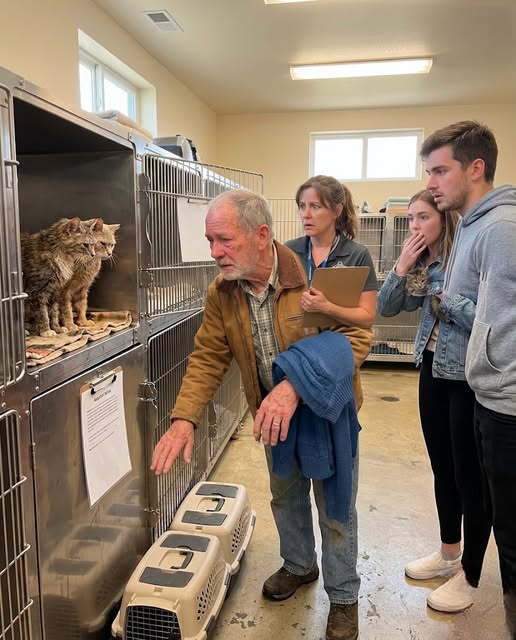
Two old cats lay pressed together in one small bed.
The gray one was thin, with cloudy green eyes and a paw resting across the orange one’s back.
The orange one had a torn ear, a wider body, and the weary face of someone who had learned not to expect good news.
They were not performing for him.
They were not cute in the bright, marketable way the kittens were cute.
They were simply together.
A volunteer named Carol came up beside Harold with a clipboard against her chest.
She had the careful voice of a person who had explained disappointment too many times.
“That’s Jasper and Finn,” she said.
Harold did not answer.
“Brothers,” she added. “Thirteen years old.”
The orange one lifted his head.
The gray one did not move his paw.
Carol told him their owner had died four months earlier.
She told him the cats had been together since they were kittens, and the shelter had promised not to split them.
Then she looked toward the front room, where the young couple was still laughing, and her mouth tightened.
“Nobody chooses thirteen-year-old cats,” she said.
She might have meant it gently.
It still landed like a door closing.
Harold noticed the notice clipped to the kennel door.
The words were plain enough.
Euthanasia review Friday if no one took them together.
It was not a threat delivered with cruelty.
It was worse.
It was a system making room.
Harold looked at those two old bodies leaning into each other, and Ruth’s last week in the hospital came back with such force that he had to grab the kennel rail.
She had been small under the blanket.
Her hand had searched for his chest in the night, the same way it had for thirty years.
“Don’t disappear after me, Harry,” she had whispered.
He had promised.
Then he had gone home and started doing exactly that.
“I’ll take both,” he said.
Carol blinked.
“Both?”
“They already lost their person,” Harold said. “They don’t have to lose each other too.”
The young couple in the front room stopped laughing.
Carol looked down at the notice, then at Harold, and all the color left her face.
Paperwork took longer than courage.
Harold signed forms, listened to instructions, nodded through medication schedules, and pretended he understood the difference between pill pockets and soft food.
Carol packed a bottle of pills, two cans of prescription food, and an adoption folder with both names written on the tab.
She handed it to him with both hands.
“Their last owner begged us not to separate them,” she said.
Harold only nodded because his throat had become useless.
Getting Jasper and Finn into the truck was not graceful.
Finn cried the whole way home in a voice that sounded insulted by motion.
Jasper stayed silent, which worried Harold more.
Inside the house, Jasper bolted under Ruth’s chair the moment the carrier door opened.
Finn followed halfway, then stopped with his torn ear sticking out, as if he could not decide whether Harold was danger or furniture.
Harold set out two bowls.
He spilled half the dry food on the floor.
He read Jasper’s medicine label six times.
He called the shelter once because he could not tell whether the pill was supposed to be split or hidden whole, and Carol talked him through it without making him feel foolish.
The first night, neither cat trusted him.
The second night, Finn ate only if Harold moved the bowl within sight of Jasper.
The third night, Jasper scratched Harold’s wrist and drew a thin red line.
Harold looked at the mark and said, “Fair enough.”
On the fourth morning, soft paws tapped across the kitchen while he fried one egg.
He looked down and found Finn watching him with the solemn judgment of a retired banker.
“She burned pancakes every Sunday,” Harold told him.
Finn blinked.
“Ruth,” Harold said. “My wife.”
He had not said her name out loud in the house since the funeral.
The room did not collapse when he said it.
That felt important.
By the fifth night, Finn had claimed Ruth’s chair.
Harold saw him there and almost told him to get down.
Instead, he stood in the doorway with one hand on the frame, watching the old cat tuck his torn ear against the cushion where Ruth’s arm used to rest.
The first tear fell before Harold could stop it.
Then another.
He did not sob loudly.
He had spent seventy-one years learning how to keep pain tidy.
But Finn looked at him, then slowly lowered his head as if the chair had accepted both of them.
On the sixth night, Harold opened the adoption folder.
He meant to put the papers in the drawer with the house insurance and Ruth’s death certificate.
A small note slipped out instead.
It was written in a shaky hand.
Please don’t separate my boys.
Harold sat down hard.
They already lost me.
Don’t make them lose each other too.
He read the note three times.
The room blurred at the edges.
Ruth had asked nearly the same thing of him, not about cats, but about himself.
She had known him too well.
She had known he would mistake breathing for living if no one called him back.
Sometimes rescue walks in on four tired feet.
That was when Jasper stopped eating.
It happened without drama.
One moment the gray cat was curled beside Finn on the rug.
The next, his bowl sat untouched, and his narrow sides moved too slowly for Harold’s comfort.
Finn kept nudging him.
Jasper did not lift his head.
Harold called the emergency vet, then hung up because he could not afford the tremble in his voice.
He wrapped both cats in Ruth’s old throw blanket and sat in the recliner with them until his legs went numb.
The blanket still carried a faint trace of lavender soap.
For a while, Harold told himself he was staying awake for Jasper.
Near two in the morning, he understood the truth.
He was staying awake because the thought of losing another living thing in that house felt like being asked to bury Ruth twice.
So he talked.
He told Jasper and Finn about Ruth’s laugh.
He told them how she sang wrong words to radio songs and refused to admit it.
He told them how she planted tomatoes too close together every spring, then blamed him when the vines fought for space.
He told them she wanted one old cat and somehow got two stubborn ones instead.
Then he said the sentence he had refused to give anyone else.
“I don’t know how to live here without her.”
Finn lifted his head.
Slowly, painfully, the orange cat pressed his warm face into Harold’s wrist.
Jasper opened one cloudy eye.
It was not a miracle.
It was not a sign written across the ceiling.
It was one small breath, then another.
Harold took it.
At dawn, Jasper licked a little food from Harold’s finger.
It was not enough for a celebration, but it was enough for a phone call.
Carol answered before the shelter opened.
When Harold told her Jasper had eaten, she made a sound that was half laugh, half prayer.
“I thought about them all night,” she admitted.
Harold looked at the two cats under Ruth’s blanket.
“Me too,” he said.
The next weeks did not make grief polite.
Ruth was still gone.
Her closet still waited closed.
Her cardigan still hung by the back door.
Some mornings, Harold still reached for the second coffee cup before remembering.
But he began pouring only one cup on purpose.
He began opening the blinds.
He learned which pill Jasper would accept and which one he would spit into the rug with theatrical disgust.
He learned that Finn snored.
He learned that two old cats could turn a silent hallway into a schedule.
Food at seven.
Medicine at seven-fifteen.
Window inspection at eight.
Nap in Ruth’s chair at nine.
Harold started talking because they expected him to.
He told them when he was folding laundry.
He told them when he found Ruth’s gardening gloves in the shed.
He told them, one Saturday afternoon, that he was scared to open her closet.
Finn yawned.
Jasper blinked.
It was rude and perfect.
The following week, Harold took Ruth’s list out again and painted one porch rail pale blue while Jasper and Finn watched through the screen door like inspectors with no mercy.
He sent Carol a picture.
She sent back a heart and a line that made him sit down on the porch step.
Ruth called us once, months ago, asking if senior cats ever found homes.
Harold read the message twice.
Then he called Carol.
She sounded nervous when she answered.
“I didn’t know until I checked the old inquiry book,” she said. “Your wife never left her last name on the voicemail, only Ruth. She asked what happened to older bonded pairs when nobody came. I told her we tried our best.”
Harold closed his eyes.
“She said she was trying to convince her husband,” Carol added softly. “She said he was a good man who needed something to take care of.”
Harold pressed the phone to his ear and looked through the screen door at Jasper and Finn asleep in the same patch of sun.
Ruth had not sent the cats to him.
Life was not that tidy.
But she had seen the empty place coming, and she had tried, in the small practical way she did everything, to leave a door unlocked.
“Thank you for telling me,” Harold said.
After that, the house changed again.
Not loudly.
Not all at once.
Harold opened Ruth’s closet on a Tuesday and cried into the sleeve of her winter coat.
He kept three sweaters, gave two boxes to the church charity drive, and tucked her gardening hat on the shelf by the back door.
He planted tomatoes too close together because she would have.
He drove to the ocean in Maine in September with a neighbor checking on the cats, and when he stood in front of the gray water, he said Ruth’s name into the wind.
It did not answer.
It did not need to.
One month after the adoption, Harold went back to the shelter with senior cat food and a check that was smaller than he wished but larger than he had planned.
Carol met him near the back kennel where Jasper and Finn had once pressed themselves into one bed.
“Ruth would have liked all of them,” Harold said.
It was the first time he said her name to someone without feeling as if the floor had vanished.
Carol’s eyes softened.
“How are your boys?”
Harold thought about Finn asleep in Ruth’s chair, Jasper warming himself by the window, and the way the house no longer seemed to hold its breath when he unlocked the door.
“Old,” he said.
Then he smiled.
“Loved.”
That night, he made one cup of coffee for the next morning and set the machine timer.
He paused before leaving the kitchen.
Across the table, Ruth’s chair was not empty.
Finn had curled there with his torn ear folded under his chin.
Jasper sat in the window, his thin body silvered by the streetlight, one paw resting against the sill.
Harold looked at them and finally understood the last part.
He had gone to the shelter thinking he was rescuing two unwanted old cats.
But he had been the one sitting outside his own life.
He had been the one too ashamed to admit he needed someone kind enough to bring him back in.
And somehow, two tired brothers had done it without asking for anything except a bowl, a blanket, and permission to stay together.
Harold turned off the kitchen light.
The house did not sound dead anymore.