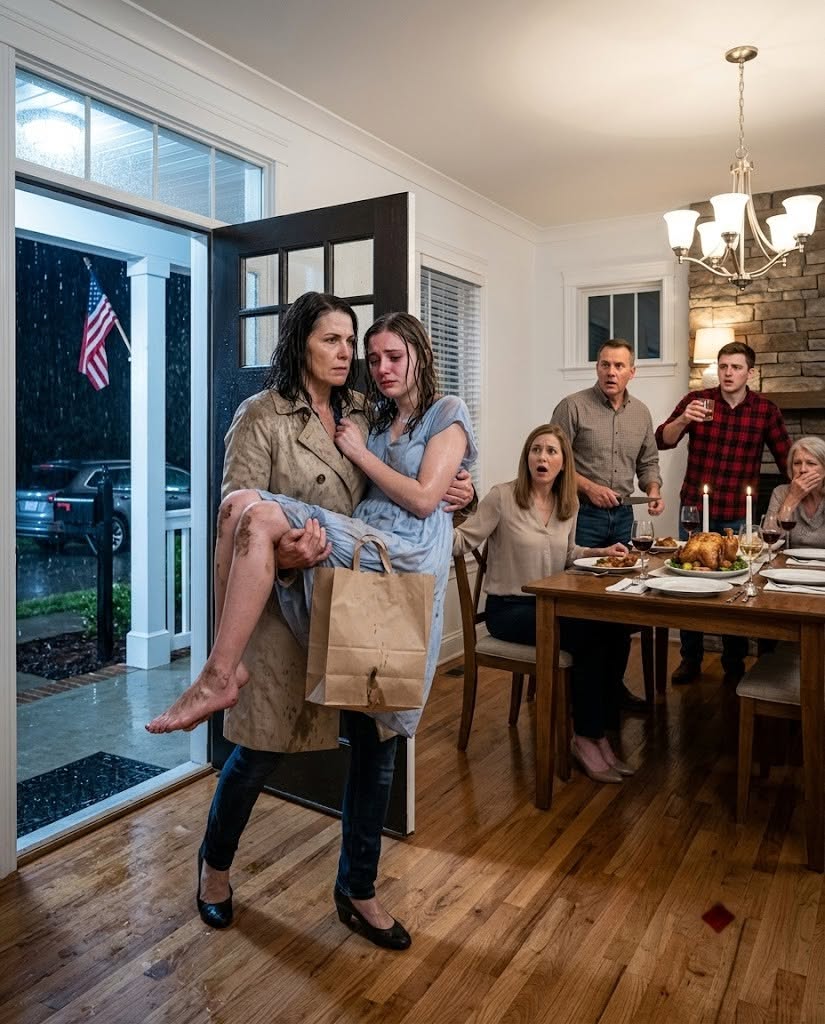
I found my daughter kneeling in the rain at the edge of Daniel Price’s driveway.
For a few seconds, I did not understand what I was seeing.
The porch light was on, warm and yellow against the gray curtain of rain, and water was running off the gutters so hard it slapped the flowerbeds like handfuls of gravel.

Emily was on her knees in the mud.
Her new blue dress was soaked through.
It clung to her shoulders, her waist, her thighs, every inch of it ruined by the storm.
Her hair was plastered to her face.
One hand held a torn shopping bag against her chest like it was something alive.
From inside the house, I heard laughter.
Not the kind people make when they are trying to hide discomfort.
Not the startled kind that slips out before guilt arrives.
This was easy laughter.
Comfortable laughter.
Laughter from people who believed they were safe.
“Emily,” I said.
She turned her head slowly.
Her lips were almost blue.
“Mom?” she whispered.
Then she said the sentence that broke through every careful lie she had told me for the past year.
“You weren’t supposed to come today.”
That was when I knew this was not the first time.
Maybe not the rain.
Maybe not the dress.
But the shame.
The control.
The punishment dressed up as a lesson.
That had been happening long before I pulled into the driveway.
The house behind her looked like any nice suburban house where a family dinner might be happening.
A small American flag snapped from the porch post.
The windows glowed.
A family SUV sat in the driveway beside Daniel’s truck.
Through the glass, I could see silhouettes around the dining table.
Candles.
Wineglasses.
People leaning close to each other.
The smell of roast beef, garlic, and warm bread drifted out when someone cracked the door to say something.
Then Daniel’s voice carried across the porch.
“Maybe next time she’ll remember whose money she spends.”
His mother laughed.
“Some women need to learn their place before they embarrass the family.”
Emily flinched.
I had seen my daughter flinch once before, when she was nine and a baseball came over the fence and hit the side of our garage.
She hated loud noises after that for a summer.
This was not that.
This was the body remembering a person.
I stepped into the rain and reached for her.
She immediately lowered her head, like being comforted was another thing she might get punished for.
“Did he hurt you?” I asked.
She looked toward the house instead of at me.
That was answer enough.
A year earlier, I had watched Daniel stand beside her in a navy suit and promise to honor her.
He had looked right at me when he said it.
He had squeezed my hand after the ceremony and called me Mom.
He was charming in the way dangerous people often are before anyone names the danger.
He knew when to hold a door.
He knew when to refill a glass.
He knew how to laugh at the right volume and ask questions that made people feel noticed.
At the wedding, his mother dabbed her eyes with a linen napkin and told every guest that Emily was exactly the kind of woman Daniel needed.
I remember thinking that was a strange way to put it.
Not the woman Daniel loved.
The woman Daniel needed.
After the wedding, Emily changed by inches.
She stopped wearing yellow.
Then she stopped meeting me for coffee unless Daniel was at work.
Then she started answering texts with sentences that sounded edited.
I’m fine.
Everything is good.
Daniel’s just stressed.
We’re figuring things out.
Mothers know the difference between a daughter who is busy and a daughter who is being watched.
At first, I tried the soft way.
I brought soup.
I invited her to lunch.
I left a folded twenty in her coat pocket once, pretending I had forgotten it there.
She called that night and cried without making a sound.
Then she said, “I can’t keep it.”
“Why?” I asked.
“He checks.”
Two words can rearrange a mother’s entire life.
After that, I stopped asking questions Daniel could punish her for answering.
I watched.
I listened.
I saved everything.
By March 14, I had screenshots of messages where he called her selfish for buying lunch at work.
By April 2 at 9:37 p.m., I had the first bank transfer record from their joint account into an account only Daniel controlled.
By May, I had a photo Emily sent and immediately deleted, showing purple marks around her wrist that she later called a cabinet accident.
By June, I had an audio file she thought was gone.
In it, Daniel said, “No one will believe you over me.”
I printed the messages.
I backed up the photos.
I made a transaction timeline.
I kept copies of pharmacy receipts, account statements, and the county clerk house paperwork that proved Emily had been paying toward a mortgage her name was not on.
For seventeen years before I became a school principal, I had worked as a federal financial investigator.
People forget that women can have whole lives before they become someone’s mother.
Daniel forgot that.
So did his family.
They saw a retired principal with sensible shoes, a quiet voice, and a habit of bringing banana bread to school fundraisers.
They did not see the woman who once traced shell accounts through three states because a man thought his wife was too tired to notice.
Control often leaves a paper trail because men like Daniel cannot imagine the people they control keeping records.
They think fear erases evidence.
It does not.
Fear makes people hide evidence in places no one thinks to look.
Emily’s fingers tightened around the torn shopping bag.
“I bought it with my paycheck,” she whispered.
Her voice was so small the rain almost swallowed it.
“It was on sale. I wanted to look nice tonight.”
“For him?” I asked.
She nodded once.
The sound from inside grew louder.
Daniel’s brother called through the cracked window, “Leave her out there until she apologizes!”
The dining room went quiet for half a breath.
Then someone laughed again.
That pause told me everything.
They all knew.
They had all heard the order.
They had all continued eating.
A family will tell you who it is by what it can ignore at the table.
That night, Daniel’s family taught my daughter that warmth was for them and the rain was for her.
I took off my coat and wrapped it around Emily’s shoulders.
It was not enough.
She was shaking too hard.
“Mom, don’t,” she said when I bent down.
I slid one arm behind her back and the other beneath her knees.
For one strange second, I remembered carrying her out of a school auditorium when she was seven, asleep after playing a tree in the spring musical.
Her cardboard leaves had been bent.
She had drooled on my shoulder.
She had trusted me with the whole weight of herself.
Now she was twenty-eight, married, grown, and apologizing with her eyes for needing help.
“Yes,” I told her.
Her wet dress soaked through the front of my blouse.
I carried her up the porch steps.
My shoes left dark prints on the mat.
Inside, Daniel’s mother said, “Don’t worry. Her mother won’t make a scene. She never does.”
She was right about one thing.
I did not make a scene.
I made an entrance.
I shifted Emily higher in my arms, lifted my foot, and kicked the front door hard enough that the frame cracked at the lock.
The laughter died instantly.
The dining room froze.
Forks stopped halfway to mouths.
Daniel’s father stood near the end of the table with a carving knife in his hand, his smile falling away before he had time to hide it.
Daniel’s brother was still half turned toward the window, mouth open from the joke he had just made.
Daniel’s mother sat at the table like a queen interrupted during court.
Daniel stood by the fireplace with a glass of whiskey.
He looked at Emily first.
Then at me.
Then at the broken doorframe.
For the first time since I had known him, Daniel Price did not know what face to put on.
Rainwater dripped from Emily’s dress onto the hardwood.
The sound was small, but in that room it might as well have been a gavel.
“What the hell are you doing?” Daniel said.
His voice was not angry yet.
It was careful.
He was trying to decide which audience he had.
A violent man in private often becomes a wounded man in public.
He reached for that version of himself.
“She’s emotional,” he said, turning slightly toward his father. “She bought something we couldn’t afford, and she got dramatic when I asked her to be responsible.”
Emily made a tiny sound against my shoulder.
I looked at him.
Then I said the five words he would never forget.
“You picked the wrong woman.”
Nobody moved.
Daniel’s mother stood so fast her chair scraped the floor.
“How dare you break into my home?”
I glanced at my daughter’s muddy knees.
I glanced at the torn shopping bag.
I glanced at every clean plate on that table.
“Funny,” I said. “That is exactly the word I was saving for you.”
Daniel tried to laugh.
It came out wrong.
“I think we all need to calm down.”
“No,” I said. “You need to listen.”
With Emily still in my arms, I moved to the nearest chair and lowered her into it.
She grabbed my sleeve when I started to straighten.
“I’m not leaving,” I told her.
Then I reached into the inside pocket of my raincoat and pulled out the folded envelope I had kept in my glove compartment for three weeks.
Daniel saw it before anyone else understood what it was.
His eyes flicked to it.
Then away.
That was the first real crack.
I opened the envelope and slid the summary sheet across the dining table.
It stopped beside the roast.
Across the top was a transaction timeline.
Dates.
Partial account numbers.
Transfer amounts.
Daniel’s name.
Emily stared at the page, confused at first.
Then she saw the line with her paycheck deposit.
Then the second line.
Then the withdrawal that happened twelve minutes later.
“I didn’t authorize that,” she whispered.
“No,” I said. “You didn’t.”
Daniel’s father lowered the carving knife until the tip touched the tablecloth.
“Daniel,” he said.
Just one word.
But it changed the air.
Daniel’s mother grabbed the back of her chair.
“This is private,” she snapped.
“What happened outside was public enough for all of you to laugh,” I said.
I placed the second page on the table.
A transcript excerpt from the audio file.
Timestamped 8:12 p.m.
Daniel’s own words sat in black ink between the wineglasses.
No one will believe you over me.
His brother leaned forward, then sat back like the page had burned him.
Emily covered her mouth.
Daniel’s face hardened.
“You recorded me?”
“She didn’t,” I said.
That was when he looked at me differently.
Not like a mother-in-law.
Not like a retired principal.
Like a problem.
Good.
He was finally catching up.
“I have copies,” I said. “Not just here.”
“You don’t know what you’re doing,” he said.
“I know exactly what I’m doing.”
Then Emily saw the third page.
Her hand moved toward it slowly.
The page showed a second address and a second account.
Her signature appeared on a document she had never seen.
She looked up at me.
“Mom,” she said, her voice breaking. “Why is my signature on that?”
Daniel said her name sharply.
“Emily.”
For the first time that night, she did not flinch.
She looked at him through wet hair and tears and something else beginning to rise in her face.
Not confidence yet.
Not peace.
Recognition.
His mother whispered, “Daniel, what did you do?”
He did not answer.
That silence told the room more than any confession could have.
I took out my phone.
At 7:48 p.m., before I left my house, I had sent the evidence packet to the attorney I had already retained for Emily.
At 7:51 p.m., I had sent a backup copy to a former colleague who knew exactly how to preserve chain of custody.
At 8:03 p.m., I had texted Emily a single word she had not yet seen because Daniel had taken her phone before dinner.
Come.
I turned the screen toward Daniel.
He read the delivery confirmations.
His face changed slowly.
The performance drained out of him.
In its place was the man my daughter had been living with.
Cold.
Mean.
Small.
“You had no right,” he said.
Emily stood up.
The coat slipped from her shoulders, and the ruined blue dress showed fully in the chandelier light.
Mud stained the hem.
The fabric was pulled at one side where the shopping bag had torn.
Her knees shook, but she stayed on her feet.
“She bought me that dress,” Daniel’s mother said suddenly, reaching for any explanation that might save her son. “Or she said she did. Maybe she spent money she shouldn’t have. Marriage has rules.”
Emily turned to her.
“I bought it with my lunch money,” she said.
The room went still again.
“I skipped lunch for two weeks because I wanted one nice thing that did not have to be approved by your son.”
Daniel’s father sat down as if his legs had stopped working.
That was the moment the family finally understood the size of what they had laughed at.
Not a dress.
Not a tantrum.
Not a wife who needed discipline.
A woman trying to keep one small piece of herself.
Daniel reached for the papers.
I put my hand on them first.
“Don’t.”
He stared at me.
“You think you can walk in here and ruin my life?”
“No,” I said. “You did that part yourself.”
Emily reached into the torn shopping bag and pulled out the receipt.
It was damp and wrinkled, but the numbers were still visible.
Twenty-nine dollars and eighty-seven cents.
That was the price of the dress Daniel had left her kneeling in the rain for.
Less than dinner for two at the diner Emily used to love.
Less than the whiskey in his glass.
Less than the flowers his mother had on the table.
His father looked at the receipt.
His face crumpled with something that looked almost like shame.
Almost.
But shame after the fact does not dry a daughter’s dress.
It does not erase the laughter.
It does not give back the months she spent saying I’m fine when she was really asking the world not to notice she was disappearing.
Emily folded the receipt once.
Then again.
Her hands were still shaking.
“Can I go home?” she asked me.
I had waited a year to hear that question.
“Yes,” I said.
Daniel stepped in front of the doorway.
“You are not taking my wife.”
Emily looked at him.
For a second, I thought she might shrink again.
Then she lifted her chin.
“I am not your punishment project,” she said.
The room was so quiet I could hear rain ticking against the windows.
Daniel’s brother looked down at his phone.
Daniel’s mother cried once, sharp and false, like a sound meant to pull attention back to her.
No one moved toward her.
No one comforted Daniel.
The table that had taught my daughter to wonder whether she deserved the rain was finally learning what silence felt like from the other side.
I helped Emily put my coat around her shoulders again.
This time, she stood while I did it.
That mattered.
At the door, she stopped and looked back at the room.
Not at Daniel.
At the table.
At the candles.
At the plates.
At the people who had heard her crying and kept eating.
“I hope it was funny,” she said.
Then she walked out into the rain with me.
We did not go back for her phone that night.
We did not go back for clothes.
We went to my house, where I gave her dry sweats, wrapped her in a blanket, and made tea she barely drank.
At 11:26 p.m., Daniel called thirteen times.
At 11:44 p.m., his mother called twice.
At midnight, Emily blocked them both.
The next morning, the attorney filed the first paperwork.
Within a week, the bank records were preserved.
Within two weeks, Emily had her own account, a new phone, and a police report documenting the incident without turning her pain into a spectacle.
The legal part took longer.
Healing took longer than that.
People like Daniel do not lose control once and disappear quietly.
They send apologies that sound like accusations.
They send flowers to workplaces.
They tell mutual friends there has been a misunderstanding.
They ask why no one wants to hear their side.
But Emily had finally heard her own.
That mattered more.
Months later, she bought another blue dress.
Not the same shade.
Brighter.
She wore it to Sunday lunch at my house with white sneakers and her hair down.
When she arrived, she stood on my porch for a moment, touching the small American flag by the railing as if checking the wind.
Then she smiled.
Not the careful smile from her marriage.
A real one.
Inside, I had soup on the stove, bread warming in the oven, and two mugs on the counter.
She came in without knocking.
That was how I knew she was home.