The call came at 8:37 PM.
I remember the exact time because I had been staring at the garage clock, wondering whether I still had enough daylight to finish replacing the belt on my old pickup.
The garage smelled like motor oil, wet cardboard, and the faint sourness of work gloves that had been used too many times and washed not nearly enough.

Rain tapped against the metal roof in uneven little bursts.
Then Sarah’s name flashed across my cracked flip phone.
Most people laughed at that phone.
Sarah used to tease me about it too.
“Dad, that thing belongs in a museum,” she would say, holding it between two fingers like it might give her tetanus.
But she was the one who programmed herself as speed dial two and the emergency contact as speed dial one, because she knew I hated digging through menus.
That was Sarah.
She made fun of me while quietly making sure I was taken care of.
When I answered, I did not hear hello.
I heard breathing.
Thin breathing.
Broken breathing.
The kind that does not come from someone who is trying to talk but from someone who is trying not to be heard.
“Sarah?” I said.
For two seconds, there was nothing but that breath and some distant sound I could not place.
Then my daughter whispered, “Dad, help.”
The call cut off.
I was in the truck before I remembered closing the garage door.
I do not know whether I did.
The rain had turned the driveway slick, and the trash cans beside the mailbox rattled when I backed out too fast.
My headlights caught the small flag my neighbor kept by his porch, whipping hard in the wind.
I thought of Sarah’s hands when she was little.
Tiny, sticky, always reaching.
She had reached for me when she took her first steps across our living room carpet.
She had reached for me when the school nurse called because she fell off the monkey bars.
She had reached for me at her mother’s funeral, one hand tucked inside mine, the other clutching a stuffed rabbit that still sat boxed in my hall closet.
I raised her alone from the time she was six.
That is not a complaint.
It is a fact.
I learned how to braid hair badly, then better.
I learned which cold medicine she hated and which chicken soup she could keep down.
I learned to sit in the truck outside a school dance without making it obvious I was sitting there because some boy had made her nervous.
I learned that daughters do not stop needing rescue when they become adults.
They just get better at pretending they do.
Jason Sterling came into her life three years before that night.
He was handsome in the effortless way money can buy polish around a weak character.
Clean haircut.
Nice watch.
Soft hands.
A smile that worked better on strangers than on people who knew how to listen beneath it.
Sarah met him through a charity event she helped organize at the office where she worked.
At first, he seemed attentive.
He brought her coffee.
He sent flowers to her desk.
He called me “sir” with a little too much shine on the word.
I did not like him.
Sarah knew that.
She told me I was judging him too fast.
“Dad, not every man with money is a villain,” she said one Sunday while helping me clean out the gutters.
“I know,” I told her.
But I also knew not every villain looks like one.
Some of them bring flowers first.
Eleanor Sterling, Jason’s mother, was worse because she did not bother hiding what she was.
The first time she met me, she looked at my truck before she looked at my face.
The second time, she asked Sarah whether I still worked “with my hands,” as though that was something a decent family should recover from.
She never called me Michael.
She called me “your father” when speaking to Sarah and “Mr. Hale” when other people were listening.
To my face, she mostly smiled.
Not warmly.
Administratively.
Like she had filed me under inconvenient.
Sarah married Jason eighteen months before the call.
The wedding was held on the Sterling lawn under white tents and rental chandeliers, because apparently even sky needed decoration if Eleanor was involved.
I walked my daughter down the aisle in a navy suit that felt too tight around the shoulders.
She looked happy.
That was the part I kept returning to later.
She looked happy enough that I swallowed every warning I wanted to give.
A father can protect his daughter from many things, but he cannot live her life for her.
Sometimes the best he can do is leave the porch light on.
So I did.
I answered every call.
I showed up when she needed help moving a dresser.
I fixed the loose step on their back deck because Jason kept saying he would hire someone and never did.
I kept quiet when Eleanor made remarks about Sarah’s clothes, her cooking, her job, her weight, her tone.
Sarah would laugh them off.
“She’s just old-fashioned,” she would say.
No.
Cruelty is not tradition.
Control only borrows old words so decent people hesitate before calling it what it is.
By the time I reached the Sterling estate, I had driven so fast that the engine smelled hot.
The house sat at the end of a long drive, windows glowing, hedges trimmed into shapes nature never asked for.
A small American flag hung beside the porch.
It looked strangely normal there.
That was the thing about places like the Sterling house.
Everything outside was trained to lie.
Jason was waiting on the porch with a baseball bat.
He wore a white shirt with the sleeves rolled up and that same lazy smirk he used whenever he wanted to remind me he owned nicer things than I did.
The bat ruined the effect.
It made him look less like a son of privilege and more like exactly what he was.
A frightened man trying to dress panic as authority.
“Go home, old man!” he shouted.
The rain had slowed to mist.
The porch light hummed over his head.
I got out of the truck and left the door open.
“Where is Sarah?” I asked.
“This is a family matter,” he said.
“She is my family.”
“She’s my wife.”
He said it like ownership.
That was when the first cold thing moved through me.
Not fear.
Recognition.
“Move,” I said.
Jason lifted the bat higher.
“She has to learn discipline,” he snapped. “She has to understand her place.”
I have heard men say things like that in rooms much dirtier than his porch.
I have heard it from men wearing uniforms, suits, wedding rings, and smiles.
The language changes.
The hunger under it does not.
“Discipline?” I asked.
Jason swung.
It was a bad swing.
Too much shoulder.
No footwork.
All anger.
I stepped inside it, caught his wrist long enough to pull him off line, and drove my fist into his stomach.
The bat hit the porch boards with a hollow crack.
Jason folded at the middle and dropped onto the steps, choking for air.
For a moment, he looked younger than he was.
Small.
Confused.
Like consequences had always been something that happened to other families.
I stepped over him and went inside.
The front hall smelled of lemon polish and expensive candles.
There was a bowl on the entry table full of decorative glass balls no one was supposed to touch.
There were family portraits up the stairs.
In all of them, Eleanor stood in the center like she had arranged the bloodlines personally.
Then I heard Sarah scream.
It came from upstairs.
After it came the sound I had heard through the phone.
Snip.
Snip.
Scissors.
I took the stairs two at a time.
The bedroom door was half shut.
I kicked it open hard enough that it cracked against the wall.
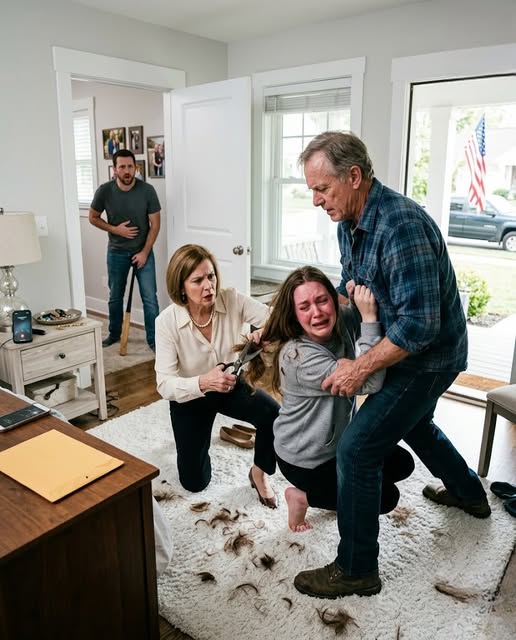
Eleanor Sterling was kneeling on my daughter.
One knee pressed into Sarah’s back.
One hand gripping her shoulder.
The other hand holding heavy fabric shears.
Sarah was on the floor in a gray sweatshirt, her cheek pressed into the rug, one hand clawing at the carpet like she could dig herself out through the floor.
Her hair lay in cut pieces around her.
Long brown pieces.
The same hair I had braided before first grade.
The same hair she had tucked under a cap when she learned to change oil with me in the driveway.
The same hair Eleanor had once called “messy” at Thanksgiving while Sarah pretended not to hear.
“This is what disobedience costs,” Eleanor spat.
I saw the shears close again.
Something inside me went quiet.
That quiet has scared better men than Jason Sterling.
For one ugly heartbeat, I imagined what my hands could do to Eleanor.
I imagined Jason crawling in and seeing his mother on the floor.
I imagined every polished thing in that room broken.
Then Sarah made a sound.
Not a scream this time.
A small, sick whimper.
That saved Eleanor from my rage.
It did not save her from me.
“Get off her,” I said.
Eleanor looked up.
At first she saw what she always saw.
Old flannel.
Work boots.
Gray at the temples.
A man she had dismissed before he entered any room.
Then she saw my eyes.
Her hand loosened.
I crossed the room, took the shears, and threw them into the far corner.
Then I lifted Sarah.
Her body was burning.
Fever-hot through the sweatshirt.
Her face was wet, but her lips were dry.
“Dad,” she whispered.
“I’ve got you,” I said.
She tried to tuck her head against my shoulder the way she had when she was little.
The movement nearly broke me.
Jason appeared in the doorway behind me, one arm wrapped around his stomach.
“What did you do?” he said, not to his mother exactly, and not to me.
Eleanor stood slowly, smoothing her blouse like posture could erase a crime.
“She was hysterical,” she said. “She needed correction.”
“Correction?” I repeated.
“She embarrassed this family.”
Sarah flinched in my arms.
I felt it.
That told me those words had been used before.
There are sentences that leave bruises no camera can photograph.
But that night, I photographed what I could.
I placed Sarah carefully on the edge of the bed, keeping one arm around her.
With my other hand, I picked up her cracked phone from the nightstand.
The screen still showed the last outgoing call.
8:37 PM.
I took a picture of the shears on the carpet.
I took a picture of the hair scattered on the rug.
I took a picture of the red pressure mark across Sarah’s shoulder where Eleanor’s knee had pinned her.
Eleanor laughed once.
It was thin.
“You think photos scare us?” she said.
“No,” I answered. “But reports like them.”
Jason swallowed.
Eleanor’s eyes narrowed.
“Reports?”
I looked at her for a long moment.
She still did not know.
That was almost impressive.
Most people who judge a man by his truck eventually make one of two mistakes.
They underestimate what he has survived, or they overestimate what he is willing to tolerate.
Eleanor had done both.
“You assaulted my daughter,” I said.
“She is my daughter-in-law.”
“She is my child.”
“You put hands on my son,” she snapped. “You entered my home. You attacked us. Do you understand who we know?”
I almost smiled.
Almost.
“No, Eleanor,” I said. “Do you understand who I am?”
Jason made a sound that might have been a laugh if he had not still been bent over.
“You’re a gardener,” he said.
That was when I reached for my flip phone.
Eleanor rolled her eyes.
“Who are you calling?” she said. “Your buddies from the hardware store?”
I opened the phone.
The old plastic hinge clicked.
Sarah’s fingers curled into my shirt.
“Dad,” she whispered, “don’t leave me.”
“I’m not going anywhere.”
I pressed speed dial one.
The line rang once.
Twice.
Then a man answered.
“Colonel Harris.”
Eleanor’s expression did not change immediately.
Jason’s did.
He looked from the phone to me, and something uncertain moved across his face.
“Colonel,” I said. “It’s Michael Hale.”
There was a pause.
Then the voice on the other end became sharper.
“Mike?”
“I have a Code Black situation at my daughter’s residence.”
The room changed.
It did not change loudly.
No thunder.
No music.
Just three people realizing at different speeds that the old man in the flannel shirt had not been bluffing.
Eleanor’s smile disappeared first.
Jason straightened half an inch, then thought better of it.
Sarah opened her eyes and looked up at me like she was remembering a version of her father she had never fully asked about.
Colonel Harris asked for the address.
I gave it to him.
Then I said, “They touched my child.”
Those four words did what my fist had not done.
They made Jason afraid.
Colonel Harris did not ask me to calm down.
Men who knew me never wasted words that way.
He asked for injuries.
I told him Sarah was feverish.
I told him she had been restrained.
I told him there were photographs of the room.
I told him I needed local medical response and law enforcement routed through proper channels, not through Sterling phone calls and golf-club favors.
That last part made Eleanor move.
It was tiny.
A glance toward the dresser.
I saw it.
Old habits do not retire.
You learn in certain rooms that the body tells the truth before the mouth remembers its lines.
I followed her eyes.
On the dresser, half hidden beneath a jewelry tray, was a manila envelope.
Sarah’s name was written across the front.
Not in Sarah’s handwriting.
Not in Jason’s.
Eleanor’s.
I kept the phone against my ear and reached for it.
“Don’t touch that,” Eleanor said.
Too fast.
Too scared.
Jason looked at her.
“Mom?”
I picked up the envelope.
It had weight to it.
Several pages, maybe more.
The flap was not sealed.
Sarah tried to lift her head.
“What is it?” she whispered.
“I don’t know yet.”
Eleanor stepped forward.
I looked at her once.
She stopped.
Colonel Harris heard the shift in the room.
“Mike,” he said, “what changed?”
“There is an envelope with Sarah’s name on it.”
“Do not let it leave your hand.”
I slid my thumb under the flap.
The first page came out folded in thirds.
It was not a letter.
It was a document.
At the top were words that made Sarah’s whole body go still.
Private Behavioral Agreement.
Jason whispered, “Mom… what is that?”
Eleanor did not answer.
I unfolded the page fully.
There were checkboxes.
Rules.
Consequences.
A signature line at the bottom where Sarah’s name had been typed but not signed.
Beside it was another page.
A schedule.
Hair appointment.
Doctor appointment.
Resignation letter draft.
I looked at Jason.
His face had gone gray.
“I didn’t know about that,” he said.
Sarah made a small sound.
Not surprise.
Recognition.
That was worse.
“What did they make you sign?” I asked her.
She shut her eyes.
Eleanor found her voice again.
“She needed structure.”
“No,” I said. “She needed help.”
“She is unstable.”
“She called me.”
“She is my son’s wife.”
I folded the page once and placed it back in the envelope.
“No,” I said. “She is leaving this house tonight.”
Jason looked at his mother, then at Sarah.
For the first time, the polished Sterling confidence cracked wide enough for something pathetic to show through.
“Sarah,” he said, “tell him this is being exaggerated.”
Sarah did not look at him.
She looked at me.
“Dad,” she whispered, “I tried to leave last week.”
The room seemed to tilt.
Eleanor’s mouth tightened.
Jason closed his eyes.
There it was.
The missing piece.
The reason for the fever.
The call.
The scissors.
The envelope.
Control does not panic until escape becomes possible.
I asked Sarah one question.
“Where are your keys?”
She swallowed.
“Eleanor took them.”
I looked at Eleanor.
She lifted her chin.
“She was not in a condition to drive.”
“Where are her keys?”
No answer.
The colonel stayed silent on the line, listening.
In another life, in another room, I had taught younger men how to control fear, how to search without turning frantic, how to understand that every object in a space can either hide truth or reveal it.
I had not wanted that life to follow me into my daughter’s marriage.
But men like Jason and women like Eleanor count on decent people staying retired from their own strength.
That night, I came out of retirement.
The keys were in the top dresser drawer under a silk scarf.
So was Sarah’s driver’s license.
So was her debit card.
So was a folded resignation letter addressed to her office.
It had not been sent yet.
I photographed each item before touching it.
Eleanor watched me do it.
Her hands had started to tremble.
“You cannot just take things from my house,” she said.
“These belong to Sarah.”
“She is part of this family.”
“She was never property of this family.”
Jason slid down against the doorframe.
Maybe his stomach still hurt.
Maybe his conscience finally did.
I did not care which.
Sirens came faintly at first.
Not close.
Not yet.
But near enough for Eleanor to hear them.
Her eyes went to the window.
That sound did more than scare her.
It offended her.
People like Eleanor do not fear consequences as much as they resent the indignity of being seen.
Sarah leaned harder against me.
“I’m sorry,” she whispered.
I looked down at her.
“For what?”
“For not calling sooner.”
The old anger in me softened around the edges.
Not for them.
For her.
“Baby,” I said, and I had not called her that in years, “you called when you could.”
That broke her.
She cried then, not loudly, but completely.
I held her while the sirens grew louder.
Jason said, “Mom, tell me you didn’t take her cards.”
Eleanor looked at him with pure disgust.
“You wanted a wife who reflected this family,” she said. “I was trying to give you one.”
He flinched like she had slapped him.
That was the first honest thing he had done all night.
Two officers reached the porch first.
Behind them came the medical crew.
Colonel Harris stayed on the phone until I confirmed names, badge numbers, and Sarah’s condition to the responding officers.
I did not shout.
I did not threaten.
I handed over the photos.
I handed over the envelope.
I handed over the shears after one officer bagged them.
The police report began in that bedroom, under warm lamp light, with cut hair still scattered across the rug.
Sarah was checked by the medical crew in the hallway.
Her fever was high enough that they wanted her transported.
She fought that at first.
“I don’t want to go alone,” she said.
“You won’t,” I told her.
I rode with her.
Jason tried to follow us out.
One officer stopped him on the porch.
Eleanor shouted something about lawyers.
The rain had stopped by then.
The porch flag hung damp and still.
My truck sat crooked at the edge of the lawn, tires sunk slightly into the perfect grass.
I remember thinking that Eleanor would care about the lawn later.
She would care about the rug.
The photos.
The neighbors seeing lights.
She would care about everything except the daughter-in-law she had pinned to the floor.
At the hospital intake desk, Sarah gave her name in a voice so small the nurse leaned closer to hear it.
I gave the timeline.
8:37 PM call.
8:52 PM second call to Colonel Harris.
Photographs taken before items were moved.
Envelope recovered from dresser.
Keys, driver’s license, debit card located in the same room.
The nurse wrote quickly.
Sarah stared at the bracelet they put on her wrist.
She looked embarrassed by it, as if needing medical care were another failure.
I hated Jason for that.
I hated Eleanor more.
Not because of the scissors alone.
Because they had managed to make my daughter apologize for surviving them.
Colonel Harris arrived at the hospital just after midnight.
He was retired, technically.
Men like him never fully are.
He wore a plain jacket and carried a folder under one arm.
He stood in the hallway outside Sarah’s room and looked at me for a long moment.
“Mike,” he said.
That was all.
Twenty-two years of history sat inside that one word.
He had known me before Sarah was born.
He had stood beside me when my wife died.
He had sent flowers to Sarah’s high school graduation because he remembered me talking about her during training weeks.
Trust is not built by speeches.
It is built by who answers when the phone rings.
He answered.
Over the next few days, things moved in the way they should have moved before Sarah ever had to whisper into a phone.
The hospital documented fever, bruising, and stress response.
The police report included the photographs.
Sarah’s office confirmed that no resignation had been filed, but the draft in the envelope matched company formatting.
Her bank flagged attempted access from Jason’s laptop two days before the incident.
That part made Sarah shake when she heard it.
“I thought I was losing my mind,” she said.
“You weren’t,” I told her.
She looked at the blanket instead of me.
“They kept saying I was dramatic.”
“That is what people say when the truth becomes inconvenient.”
Jason called six times the first morning.
Then he texted.
Then he sent a message through a cousin.
By afternoon, his tone had changed from angry to pleading.
By evening, it had become what men like him always reach for last.
Victimhood.
He said his mother had gone too far.
He said he never wanted Sarah hurt.
He said marriage was complicated.
Sarah read the messages once.
Then she handed me the phone.
“Can you save them?” she asked.
I did.
Screenshots.
Timestamps.
Backups.
A father learns new kinds of protection as the world changes.
Sometimes it is holding a hand across a street.
Sometimes it is preserving evidence before a guilty man deletes his own words.
Eleanor’s lawyer contacted Sarah two days later.
The letter called the incident a misunderstanding.
It described Sarah as emotionally unstable.
It suggested family counseling.
It requested that Sarah return certain “household property.”
Her keys, license, and debit card were not mentioned.
Colonel Harris read the letter once and laughed without humor.
Then he placed it in the folder with everything else.
“People like this count on exhaustion,” he said.
He was right.
They count on the victim being too tired to keep paperwork.
Too ashamed to repeat details.
Too afraid of sounding dramatic.
Too loyal to expose the people who hurt them.
But Sarah had called me.
That call became the first thread.
We pulled carefully.
Everything came loose.
The behavioral agreement.
The resignation draft.
The missing cards.
The text messages where Jason told her she was “lucky” his family was willing to fix her.
The email from Eleanor to Jason with the subject line: After Tonight She Will Understand.
That was the line that changed him from pitiful to finished in my mind.
He had known enough.
Maybe not every detail.
Enough.
Enough is a terrible word when someone you love is on the floor.
Sarah stayed with me after the hospital released her.
The first night, she slept in her old room under a quilt her mother had made.
I stood in the hallway longer than I should have, listening to the house breathe around her.
The refrigerator hummed.
The old floorboards settled.
Rainwater dripped from the gutter outside.
For the first time in too long, my daughter was behind a door no one in the Sterling family could open.
In the morning, she came into the kitchen wearing one of my old sweatshirts.
Her hair was uneven, shorter on one side where Eleanor had cut the most.
She touched it like she was touching someone else’s face.
“I look ridiculous,” she said.
“No,” I said.
She gave me a tired look.
“Dad.”
I set a mug of coffee in front of her.
“You look alive.”
She cried into the mug.
Not because the sentence was beautiful.
It was not.
It was blunt and clumsy and mine.
But it was true.
Weeks later, when statements had been taken and lawyers had stopped trying to scare her with polished letterhead, Sarah asked me why I had never told her more about my work at Quantico.
We were sitting on the front porch.
The evening was warm.
My pickup sat in the driveway with one headlight slightly dimmer than the other.
A neighbor’s dog barked down the street.
“I wanted you to know me as your dad,” I said.
She looked at me for a long time.
“I did,” she said. “That’s why I called.”
That stayed with me.
Not the punch.
Not the sirens.
Not Eleanor’s face when the phone connected.
That sentence.
That was the truth waiting under all of it.
I had spent years wondering whether I had protected Sarah enough.
Whether I had missed signs.
Whether I had been too quiet, too polite, too willing to let her choose while I stood nearby with every warning locked behind my teeth.
But she had called.
In the worst room of her life, with scissors closing and fever burning through her skin, my daughter reached for the one person she still believed would come.
And I did.
The Sterling house looked perfect from the road.
The lawn recovered.
The porch flag dried.
The upstairs rug was probably replaced.
People like Eleanor always replace the visible things first.
But some damage refuses to stay hidden once the right door opens.
Sarah did not heal all at once.
No one does.
She had nights when a phone ringing made her flinch.
She had mornings when she touched her hair and went quiet.
She had days when she blamed herself for not leaving sooner.
On those days, I reminded her of the only thing that mattered.
She called when she could.
She survived long enough to say, “Dad, help.”
That was not weakness.
That was the part of her they failed to break.
An entire family had tried to teach my daughter that obedience was the price of being loved.
But love does not pin you to the floor.
Love does not hide your keys.
Love does not cut pieces off you and call it discipline.
Love answers the phone.
Love drives through the rain.
Love steps over the man with the bat and goes upstairs.