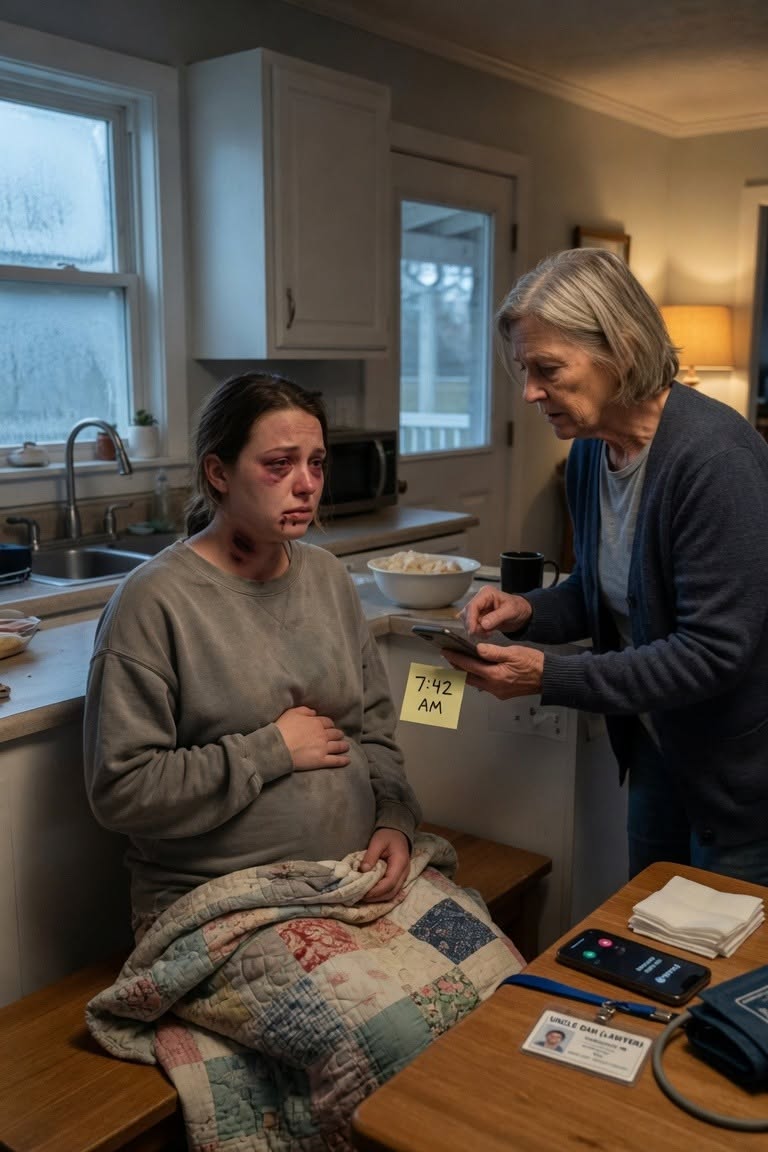
At 4 a.m., my pregnant daughter showed up at my door, barely able to stand, one hand clutching her stomach.
“My sister-in-law,” she whispered through tears. “She said my baby didn’t belong in their wealthy family.”
In that moment, something inside me turned to ice.
For twenty years, I had taught my daughter to be gentle.

That morning, I learned there is a difference between gentleness and surrender.
I am sixty-three years old, and I spent twenty-seven of those years working in an ER trauma unit.
I have seen men pray with blood on their hands.
I have seen wives apologize for bruises they did not put on their own bodies.
I have seen mothers stand under fluorescent lights and bargain with God over children who were too young to understand why a room smelled like antiseptic and fear.
When I retired, I moved into a small house past the last mailbox on our road because I thought distance could quiet memory.
Most mornings, it did.
I had my biscuit dough.
I had my black coffee.
I had frost on the sink window and a little American flag clipped to the back porch rail that snapped gently whenever the wind came over the fields.
Then my daughter hit the porch.
It was not a knock.
It was not a polite sound.
It was a body giving out.
The thud came first, then a wet, ragged gasp that made every old nurse instinct in me stand straight up.
I opened the back door and saw Maya on her hands and knees on the frozen porch boards.
One hand was pressed to her stomach.
The other kept sliding against the wood because she was shaking too badly to hold herself up.
“Mama,” she whispered.
I wanted to scream.
I did not.
Nurses do not scream when somebody is still breathing.
We count.
We assess.
We put terror in a chair and tell it to wait.
I got one arm under Maya’s shoulder and helped her inside.
Her weight sagged against me in a way I remembered from hospital hallways and car wrecks and women who had learned to make themselves smaller around angry people.
I locked the door behind her.
The deadbolt made a hard, final sound.
In the kitchen light, I saw what darkness had hidden.
Her lip was split.
One eye had swollen nearly shut.
Finger marks circled her throat in dark, uneven patches.
When I touched the side of her sweatshirt, she flinched so sharply I pulled my hand back before she could apologize.
That was Maya.
Hurt and still trying not to trouble anyone.
“Maya,” I said, forcing my voice into the low calm I used to use on patients, “who did this?”
She folded both hands around her lower belly.
“Celeste,” she whispered.
Celeste Vanguard.
My daughter’s sister-in-law.
Marcus Vanguard’s older sister.
A woman with perfect coats, perfect teeth, and the kind of polished cruelty that never left fingerprints in public.
The Vanguards were wealthy in that old, practiced way where nobody needed to mention money because the rooms did it for them.
Their names were on plaques.
Their donations bought smiling photographs in newsletters.
They spoke gently while making sure you understood exactly where they believed you belonged.
They had never called Maya poor.
They were too careful for that.
They called her sweet.
They called her simple.
They called her “refreshing.”
They called her “a nice girl from a different background.”
Every phrase had the same blade tucked inside it.
Maya had loved Marcus for three years.
She packed his lunches when he was running between interviews.
She stood beside him at hospital fundraisers where his family’s friends asked him about research and asked her whether she was “keeping busy.”
She signed birthday cards to his mother because Marcus forgot.
She remembered Celeste’s kids’ school plays because Celeste liked being remembered.
Maya believed kindness could earn a place at any table.
I let her believe it too long.
Kindness is a beautiful thing until cruel people mistake it for permission.
“Mama,” she said again.
Her voice broke so small I almost missed it over the hum of the refrigerator.
“I’m eight weeks pregnant.”
The kitchen stopped being a kitchen for a second.
The clock above the stove read 4:07 a.m.
My phone sat near the flour canister.
The county hospital was twenty-two minutes away if the roads stayed clear.
My old blood pressure cuff was in the hallway closet.
Clean gauze was in the second drawer.
A retired nurse does not stop knowing what danger looks like just because she no longer wears the badge.
“I told her,” Maya whispered.
She stared at the flour dust on the counter instead of looking at me.
“I thought maybe the baby would make them happy. I thought maybe they’d finally stop looking at me like I stole something.”
I put two fingers on her wrist and counted.
Her pulse was too fast.
“What happened?” I asked.
Maya swallowed.
Her fingers trembled against her stomach.
“She said I was trapping Marcus.”
I kept my face still.
“She said their family didn’t spend generations building wealth just for me to breed my way into it.”
My hand tightened around her wrist.
I made myself loosen it.
“She shoved me,” Maya said.
Her good eye filled again.
“Down the stairs. And when I was on the floor, she kept yelling. She kept saying my baby didn’t belong in their family.”
There are sentences a mother hears and survives.
Then there are sentences that split something open so cleanly you can hear your old self fall away.
“Where was Marcus?” I asked.
Maya closed her good eye.
That was the answer before she spoke.
“He was there.”
The kitchen light buzzed above us.
Outside, the wind dragged a branch along the siding with a dry scraping sound.
Maya touched her throat and winced.
“He stood at the top of the stairs,” she said.
Her voice was barely there now.
“He told me to stop screaming because I was embarrassing him. He said I was overreacting.”
For twenty years, I had raised Maya with every gentle lesson I knew.
Be patient.
Be kind.
Do not answer cruelty with cruelty.
Do not lower yourself.
I meant those lessons when I gave them.
I still believe in them.
But no lesson is holy enough to ask your child to bleed quietly.
For one ugly heartbeat, I pictured driving to the Vanguard house and putting my hands on Celeste myself.
I pictured dragging that woman down her own polished staircase by the pearls she wore to Sunday brunch.
I pictured Marcus finally seeing what overreacting looked like when a mother stopped being polite.
Then Maya made a small sound.
Not a word.
Just pain.
It brought me back to the kitchen.
Rage is easy.
Evidence is harder.
Evidence is what survives rich people.
I wrapped Maya in the old quilt from the laundry room and shifted her gently toward the light.
She kept apologizing without using the word.
Every wince said it.
Every attempt to sit straighter said it.
Every time she tried to make her breathing quieter, I saw the damage those people had already done.
I washed my hands.
I dried them on a dish towel.
Then I took three photographs at 4:14 a.m.
One of her throat.
One of her swollen eye.
One of the dirt and frost beneath her fingernails.
I wrote the time on a yellow sticky note and placed it in the frame of the last photo.
Memory gets questioned when wealthy families hire men in navy suits.
At 4:18 a.m., I pulled my retired nurse badge from the junk drawer and laid it beside her on the table.
At 4:21 a.m., I checked her abdomen, pupils, breathing, and pain response.
At 4:24 a.m., I locked the deadbolt again, even though it was already locked.
Sometimes the hand needs to do what the heart cannot trust yet.
Maya grabbed my sleeve.
“Mom, don’t call the police in their neighborhood,” she said.
Her voice cracked on the word please before she even said it.
“Marcus said they’d say I fell.”
I believed her.
Not because I believed every officer could be bought.
Because I had filled out enough hospital intake forms to know the difference between justice and paperwork written by people who already chose a side.
I had seen reports that made bruises sound like misunderstandings.
I had seen women corrected by husbands while nurses stood three feet away.
I had seen rich men smile at security guards while poor women tried to find their shoes.
So I did not dial 911 first.
I opened the old contacts folder in my phone.
There was a number in there I had not used in nearly eight years.
Arthur.
My brother.
Senior partner at a law firm that handled families whose last names appeared on hospital wings, scholarship funds, and marble lobby walls.
Arthur had our father’s calm voice and our mother’s memory for insult.
He did not raise his voice.
He did not threaten.
He documented.
He filed.
He dismantled.
When we were children, our father taught us that anger was a match and discipline was a furnace.
A match could scare somebody.
A furnace could change the shape of steel.
Maya watched me with one eye swollen shut and the other full of terror.
“What are you doing?” she asked.
“What I should have done the first time they made you apologize for being hurt,” I said.
The first time had been at a fundraiser eighteen months earlier.
Celeste had introduced Maya to a donor’s wife as “Marcus’s little project.”
Maya laughed because she did not know what else to do.
Marcus told her later she had made things awkward by looking upset.
I remembered Maya calling me from the parking lot, whispering from inside their SUV, saying she was fine.
She had not been fine.
She had been practicing.
Women do not become silent all at once.
They are trained, correction by correction, until even pain asks permission to speak.
At 5:00 a.m., Arthur picked up on the fourth ring.
“Evy?” he said.
His voice was thick with sleep.
“What’s wrong?”
I looked at the flour on my hands.
I looked at the quilt around my daughter’s shoulders.
I looked at the marks on her throat.
Then I said the one sentence our father had taught us never to waste unless the house was already burning.
“It’s time, Arthur.”
On the other end of the line, my brother went completely silent.
Then he asked, “Is she safe enough to speak?”
Not what happened.
Not are you sure.
Not one soft, useless sentence people reach for when powerful names enter the room.
That was why I had called him.
“She can speak,” I said.
“But she needs the hospital first.”
“Good,” Arthur said.
Now he sounded awake.
“Photographs. Timestamps. Medical intake. No calls to the Vanguards until I tell you.”
Maya’s phone lit up on the table.
Marcus.
The name glowed against the wood like something poisonous.
Maya shook her head.
“Don’t answer.”
“I won’t,” I said.
The call ended.
For three seconds, the kitchen was quiet except for the refrigerator and Maya’s thin breathing.
Then a voicemail notification appeared.
Maya went pale.
Not frightened pale.
Recognition pale.
“Mom,” she whispered.
Arthur heard her through the speaker.
“Evy,” he said, “put that phone in airplane mode and do not delete a thing.”
I did exactly as he said.
Then I pressed play.
Marcus’s voice filled my kitchen.
He did not sound panicked.
That was the worst part.
He sounded annoyed.
“Maya, stop being dramatic,” he said.
My daughter squeezed her eyes shut.
“You fell because you were hysterical. Celeste barely touched you. If you try to turn this into some kind of accusation, you need to understand what you’re doing to this family.”
Arthur said nothing.
I watched Maya fold forward under the weight of every word.
Marcus kept talking.
“And don’t tell your mother some twisted version. She already hates us because she doesn’t understand our world. We’ll handle this privately. My father knows people. You don’t want this in a police report.”
There it was.
Not an apology.
Not concern for the baby.
A warning.
Arthur exhaled once.
It was the only sound he made before his lawyer voice arrived.
“Save that voicemail in two places,” he said.
“I’m on my way to you. Take her to the hospital now. Ask for intake documentation. Use the words domestic assault and pregnancy. Do not soften them. Do not let anyone write fall without writing patient disputes that account.”
Maya looked at me.
Her mouth trembled.
“Mom,” she said, “what if they really do make it disappear?”
I put one hand over hers.
“You are done disappearing for them.”
That was the first time she cried without trying to hide it.
By 5:32 a.m., I had her in my old SUV with the quilt around her shoulders and a clean towel folded under her side.
The sky was still dark.
Frost shone on the mailbox posts as we drove past them.
Maya kept one hand on her stomach the whole way.
At the county hospital, the intake nurse looked at Maya’s face and did not ask foolish questions.
She handed me a clipboard.
Arthur had told me exactly what to write.
At 6:03 a.m., the hospital intake form listed the complaint as assault during early pregnancy.
At 6:11 a.m., a nurse photographed visible injuries for the medical file.
At 6:26 a.m., a physician examined Maya and ordered monitoring.
At 6:40 a.m., Arthur walked into the hospital corridor in a charcoal coat with his hair still damp from the shower and a leather folder tucked under one arm.
He hugged Maya first.
Carefully.
Not like a lawyer.
Like an uncle who remembered buying her popsicles after kindergarten.
Then he looked at me.
“Do they know where she is?”
“No.”
“Good.”
That lasted four minutes.
At 6:44 a.m., Marcus walked into the waiting area with Celeste behind him.
She wore a cream coat and pearls.
Of course she did.
Some people dress for innocence the way others dress for church.
Marcus saw Arthur first.
His stride changed.
Celeste saw Maya through the half-open exam room curtain.
For one second, her face did exactly what cruel faces do when they think no one important is watching.
She smirked.
Then Arthur stepped into her line of sight.
The smirk disappeared.
“Mrs. Delgado,” Marcus said to me, using the polite voice he saved for donors and photographs.
“We need to clear up a misunderstanding.”
Arthur turned his head slowly.
“Dr. Vanguard,” he said, “you should stop speaking.”
Marcus blinked.
Celeste lifted her chin.
“This is a private family matter.”
“No,” Arthur said.
His voice was quiet enough that everyone nearby leaned in without meaning to.
“It became something else when a pregnant woman arrived at her mother’s house with throat marks, a split lip, abdominal pain, and a voicemail telling her not to let this become a police report.”
Marcus’s face lost color.
Celeste looked at him.
That was the first crack between them.
“You called her?” Celeste asked.
“I was trying to calm her down,” Marcus snapped.
Maya heard him from behind the curtain.
I saw her shoulders curl.
For one moment, the old Maya tried to return.
The one who would have apologized.
The one who would have said she misunderstood.
The one who would have carried everybody else’s comfort until it crushed her.
Then her hand moved to her stomach.
She looked at me.
I shook my head once.
Not harshly.
Just enough.
She turned toward the doorway and spoke.
“He watched her push me.”
Marcus froze.
The waiting area changed.
A man with a paper coffee cup lowered it without drinking.
A woman near the vending machine looked away and then looked back.
A nurse at the desk stopped typing.
Celeste’s mouth tightened.
“You ungrateful little—”
Arthur lifted one hand.
“Finish that sentence in a hospital corridor,” he said, “and I will make sure it appears in the statement I file before lunch.”
Celeste stopped.
I had seen wealthy people angry before.
Their anger always looked a little confused when consequences did not step aside for them.
Arthur did not shout.
That would have made it easier for them.
He asked for the charge nurse.
He requested security.
He documented who had entered the waiting area and at what time.
He used process like a locked door.
By 7:18 a.m., security had asked Marcus and Celeste to leave the exam area.
By 7:40 a.m., a police report had been started from the hospital, not from the Vanguard neighborhood.
By 8:05 a.m., Arthur had a copy of the voicemail preserved.
By 8:22 a.m., Maya stopped shaking long enough to sign her own statement.
That signature mattered.
Not because paper heals anything.
Paper does not put breath back into the moment you lost it.
Paper does not erase the sound of your body hitting stairs.
But paper can keep powerful people from rewriting the floor beneath you.
Celeste tried anyway.
Of course she did.
By noon, Marcus’s father had called Arthur’s office.
By 12:17 p.m., a man in a navy suit had left a message suggesting that everyone would benefit from discretion.
By 12:31 p.m., Arthur forwarded that message to the proper file and wrote only one sentence in reply.
All communication goes through counsel.
Maya stayed in the hospital until the doctor was satisfied she could go home with instructions and follow-up care.
The baby was still there.
Tiny.
Unseen.
Stubborn as hope.
When the doctor told her, Maya covered her face and cried so hard I thought her ribs would hurt all over again.
Arthur stepped out into the hall.
I stayed beside her.
I did not tell her everything would be fine.
Women like us know when a sentence is too easy.
Instead, I held her hand and said, “Today we know what is true.”
That was enough for that minute.
The weeks after that were not clean.
People who expect instant justice have never watched a wealthy family panic.
The Vanguards sent messages through relatives.
Then through friends.
Then through people who claimed to be neutral.
Neutral people always know exactly which wounded person should be quieter.
Marcus left flowers on my porch once.
I threw them in the outside trash without bringing them into the house.
Celeste claimed Maya had been unstable.
Then she claimed Maya had slipped.
Then she claimed she had only tried to help her stand.
Every version had one problem.
Evidence.
The hospital intake form did not flatter them.
The photographs did not flatter them.
The voicemail did not flatter them.
And Maya, my gentle daughter who had spent three years trying to earn warmth from a family that measured bloodlines like bank accounts, finally stopped protecting Marcus from the truth of what he had become.
She gave a statement.
Then she gave another.
Then she sat across from Arthur in my kitchen with a mug of ginger tea between her hands and told him everything she had once minimized.
The fundraiser insult.
The holiday dinner where Celeste joked that Maya would “water down the family brand.”
The afternoon Marcus told Maya not to wear a thrifted dress to his mother’s event because people would notice.
The time Maya cried in their bathroom and Marcus told her she was too sensitive for his world.
Arthur wrote it all down.
I watched my brother work and remembered our father’s furnace.
Discipline.
Heat held long enough to change steel.
In the months that followed, the legal process moved at the speed legal processes move.
Slow enough to test you.
Steady enough to matter.
There were statements.
There were filings.
There were calls I did not answer.
There were mornings Maya sat at my kitchen table and stared at the frost on the window as if the world outside had become a country she no longer knew how to enter.
But she kept going.
She went to medical appointments.
She ate when I put food in front of her.
She slept with her phone outside the bedroom because the sound of it buzzing made her hands go cold.
And little by little, the silence that had been trained into her began to loosen.
One evening, she stood on my back porch in one of my old flannel shirts, looking at the little flag clipped to the rail.
The sun was going down.
The mailbox shadows stretched across the road.
She said, “I thought being loved by him meant proving I wasn’t after his money.”
I waited.
She touched her stomach.
“But he let them treat me like I was stealing from them just by existing.”
That was the sentence I had been waiting for.
Not because it was neat.
Because it was hers.
The day she finally faced Marcus in a formal conference room, she did not raise her voice.
She wore jeans, a soft blue sweater, and the plain sneakers she had bought herself after leaving his house.
Arthur sat beside her.
I sat behind her.
Marcus looked smaller than I remembered.
Celeste was not there.
Her lawyer was.
Marcus tried to look wounded.
He tried to look misunderstood.
He said he had been scared.
He said things had gotten out of hand.
He said Maya knew how intense his family could be.
Maya listened.
Then she placed both hands flat on the table.
The tremor was still there, but only I knew to look for it.
“You told me to stop screaming because I embarrassed you,” she said.
Marcus looked down.
“You left me on the floor.”
No one interrupted.
“You called me afterward to make sure I stayed quiet.”
Arthur slid the transcript of the voicemail forward.
Marcus stared at it like paper had betrayed him.
It had not.
Paper had simply refused to lie for him.
In the end, the Vanguards did what people like that often do when they cannot win cleanly.
They tried to settle the story into something smaller.
A misunderstanding.
An emotional night.
A family conflict.
Maya did not let them.
She did not need to destroy them.
That surprised me, though maybe it should not have.
She only needed to stop carrying their version of her.
The legal consequences belonged where they belonged.
The family consequences belonged where they belonged.
And Maya’s healing belonged to Maya.
Her baby was born months later on a rainy morning that made the hospital windows look like watercolor.
I was there.
Arthur was there too, pretending he had only stopped by for a minute while holding a stuffed bear the size of a grocery bag.
Maya cried when the nurse placed that child against her chest.
This time, nobody told her she was embarrassing anyone.
This time, nobody told her she was overreacting.
This time, her hands shook for a different reason.
The baby belonged exactly where she was.
In her mother’s arms.
In a room where no one had to earn kindness from people who confused wealth with worth.
Later, when the hallway quieted and the nurse dimmed the lights, Maya looked at me and said, “I don’t want her raised to be afraid of being gentle.”
I looked at my granddaughter’s tiny hand curled against Maya’s sweater.
“She won’t be,” I said.
Then I thought of my own kitchen at 4:07 a.m., the flour on the counter, the frost under Maya’s fingernails, and the old lessons sitting heavy in my chest.
For twenty years, I had raised my daughter to be soft in a world that rewards teeth.
I still wanted softness for her.
I just wanted it paired with a locked door, a clear record, a voice that did not apologize for pain, and people behind her who knew exactly when to say, “It’s time.”