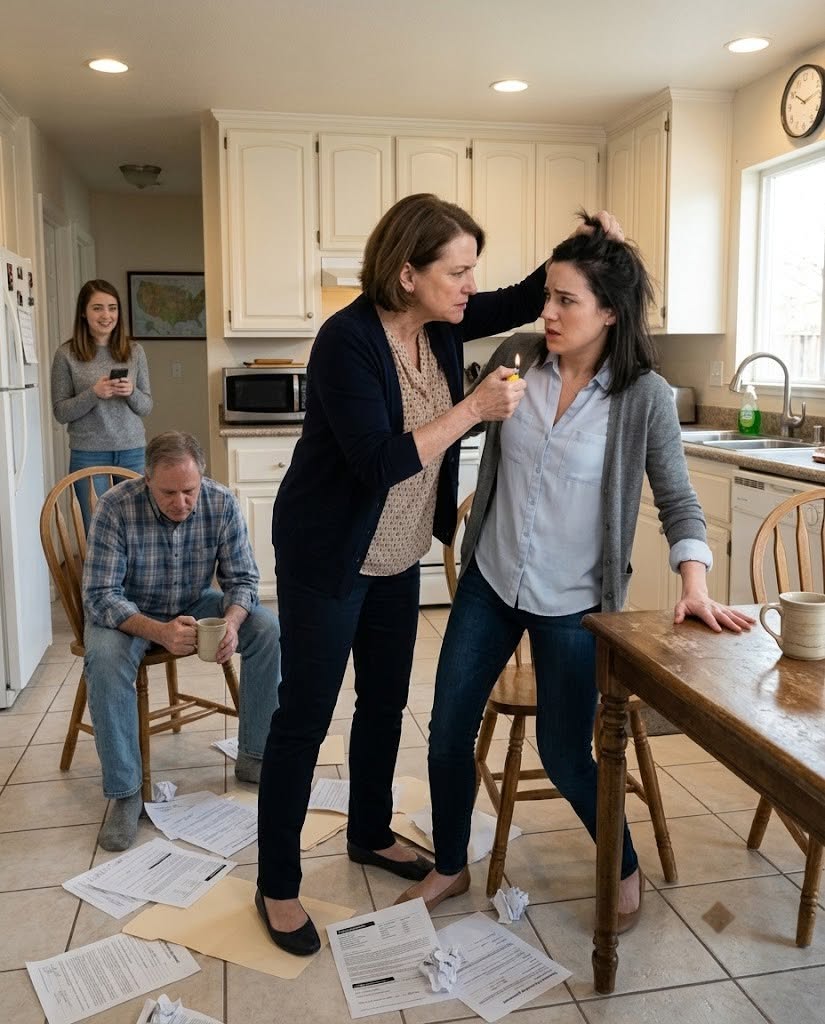
When I told my mother I had bought a house after saving for ten years, she grabbed my hair and held a lighter near my face.
“You’re not even married,” she spat. “That money was for your sister’s wedding.”

That was the moment I should have understood there was no version of my life my family would celebrate unless they owned it first.
But I had spent most of my adult life trying not to believe that.
My name is Audrey Miller, and I saved for ten years to buy my first house.
Not inherited.
Not gifted.
Not handed to me by a husband, a parent, or luck.
Mine.
Ten years of overtime shifts that made my feet ache all the way up to my hips.
Ten years of bringing leftovers to work in plastic containers while my coworkers ordered lunch and told me I was too young to live like I was already old.
Ten years of saying no to weekend trips, no to concerts, no to new clothes unless the old ones had seams giving out.
I kept a spreadsheet on my laptop called “House Money.”
It was not poetic.
It was ugly and practical.
Every paycheck went through it.
Every bonus.
Every tax refund.
Every extra hour I worked when someone called out and management needed a body.
By the time I was thirty-three, the numbers stopped looking like punishment and started looking like a door.
I found the house in late spring.
It was not fancy.
It had white walls, a narrow driveway, old cabinets, and a front porch just big enough for one chair and a potted plant.
But the roof was solid, the inspection was clean enough, and when I stood in the empty kitchen for the first showing, I heard silence.
Not the sharp silence of my parents’ house.
Not the silence that came before judgment.
A quiet that belonged to me.
I made the offer two days later.
The purchase agreement came through on a Tuesday at 2:18 PM.
I remember the time because I stared at the email in my car for nearly five minutes before I opened it.
My hands were shaking so badly I had to set the phone in my lap.
The lender had already reviewed my pay stubs, bank statements, tax returns, and the source of funds for the down payment.
There was nothing mysterious about the money.
There was only work.
The down payment receipt had my name on it.
The cashier’s check had my name on it.
The loan estimate had my name on it.
The purchase contract had my name printed so clearly it felt like the first honest sentence anyone had ever written about me.
Audrey Miller.
Owner.
I should have kept the news to myself until the keys were in my hand.
That is what my friend Megan told me when I called her from the parking lot.
“Audrey,” she said, “please do not give your mother a chance to ruin this before it is real.”
I laughed because I wanted to believe she was exaggerating.
Megan had known my family since college.
She had watched my mother call me selfish for working holidays, then ask me to pay for Celine’s car repairs because “family helps family.”
She had watched my father apologize with his eyes and nothing else.
She had watched my sister accept every favor like it was delayed payment for being loved more loudly.
Still, some part of me wanted to walk into that kitchen and be seen.
Not praised.
Just seen.
That was my mistake.
I drove to my parents’ house in Richmond with the folder on the passenger seat.
The folder was cheap black plastic from an office supply store, but I carried it like a diploma.
Inside were the sales contract, the closing disclosure, the down payment receipt, and the lender’s email confirming everything was cleared for closing.
The house smelled the way it always did.
Burnt coffee.
Lemon dish soap.
A faint trace of the lavender spray my mother used when she wanted visitors to think our home was calmer than it was.
My mother, Eleanor, stood by the counter with a dish towel over her shoulder.
She had that look she got when she was already annoyed but waiting to decide what story would justify it.
My father, Arthur, sat at the table with a mug in front of him.
He had not drunk from it.
He rarely did when my mother was in that mood.
Celine was near the hallway with her phone in her hand.
She was twenty-nine, engaged, and already talking about her wedding like it was a community emergency.
She wanted the expensive venue.
She wanted the dress appointment two states away.
She wanted a photographer whose deposit cost more than my first car.
Every conversation in that house had become a quiet auction of my labor.
No one said it directly at first.
That was never how my mother worked.
She spoke in hints.
She mentioned how expensive weddings were.
She mentioned how lucky I was not to have children.
She mentioned that my rent was “manageable” and that some people had bigger milestones coming.
The first time she suggested I could “contribute something meaningful,” I told her I was saving for my own place.
She smiled like I had made a joke in bad taste.
“A single woman does not need a house,” she had said.
I should have listened to the warning inside that sentence.
On the night I told them, I set the folder on the kitchen table.
The ceiling fan clicked above us.
The coffee maker hissed on the counter.
My father looked at the folder and then at me with a flash of something almost like worry.
“I bought a house,” I said.
No one answered.
So I kept going.
“I get the keys in two weeks. The lender cleared everything. I signed the purchase agreement.”
For one second, the room stayed perfectly still.
Then my mother looked at me as if I had confessed to a crime.
“You’re not even married,” she said.
It was not a question.
It was a verdict.
“What do you need a house for?”
I had imagined surprise.
I had prepared for criticism.
I had not prepared for the disgust in her voice.
“Because I paid for it,” I said. “Because I wanted it.”
Celine laughed softly from the hallway.
That laugh had followed me through half my life.
It had been there when I bought my first used car and my mother told me Celine needed rides more than I needed independence.
It had been there when I got promoted and Celine said, “Must be nice to have no real responsibilities.”
It was there again when my mother stepped toward me.
“That money was for your sister’s wedding,” Eleanor said.
The sentence came out so cleanly I almost missed how insane it was.
“No,” I said.
My mother’s eyes narrowed.
“Excuse me?”
“No,” I repeated. “That money is mine. I earned it. I saved it. It was never promised to Celine.”
My father shifted in his chair.
The mug scraped against the table.
For one foolish second, I thought he might speak.
He did not.
My mother moved closer.
“Your sister is starting her life,” she said.
“So am I.”
That was when her face changed.
Not into anger.
Anger would have been loud.
This was worse.
This was calm.
People think rage is the most dangerous thing in a family.
It isn’t.
The most dangerous thing is entitlement that has been mistaken for love for so long it thinks resistance is betrayal.
My mother reached out and grabbed my hair at the scalp.
The pain was immediate and bright.
My head snapped back before I could stop it.
The folder slid from the table and hit the tile.
Papers spilled everywhere.
The sales contract skidded under a chair.
The down payment receipt landed near my father’s shoe.
The closing disclosure folded in half against the leg of the table.
My mother held me with the skill of someone who knew exactly how to hurt without leaving obvious marks.
Then she opened the junk drawer.
The sound of it sliding out was small, but I still hear it when the house gets too quiet.
She took out a lighter.
It was the cheap kind, plastic and scratched, the one my father used to light birthday candles and the grill.
She flicked it once.
Nothing.
She flicked it again.
A small blue-orange flame appeared.
Celine stopped laughing.
My mother brought the flame close enough that I felt heat on my cheek.
I smelled shampoo.
I smelled coffee.
I smelled hot plastic.
“If you won’t be part of this family the easy way,” she whispered, “you’ll learn the hard way.”
My body wanted to fight.
My mind did something colder.
It watched.
It recorded.
My father’s hand tightened around his mug.
“Eleanor,” he said weakly. “Enough.”
Enough.
Not stop.
Not let her go.
Not what are you doing.
Just enough, like my mother had salted soup too heavily.
Celine crossed her arms.
“All this drama over a house,” she said. “Just rent and move on.”
That was the moment something inside me separated from them.
The ceiling fan kept clicking.
The coffee maker kept hissing.
My father stared at the table instead of at me.
Nobody moved.
Not toward the lighter.
Not toward my mother.
Not toward me.
And in that frozen kitchen, I understood the truth.
She did not want my money.
Money was only the excuse.
She wanted proof that I still belonged beneath her hand.
When my mother finally snapped the lighter shut, the click felt louder than the flame had.
She let go of my hair like she was dropping a leash.
My scalp burned.
My eyes watered.
I did not wipe them.
I bent down and gathered the papers from the floor.
My father lifted his shoe so I could pick up the down payment receipt.
He still did not look at me.
That small movement, somehow, hurt more than the hair pull.
He could make room for the paper.
He could not make room for me.
I put every page back into the folder.
Then I stood.
My mother watched me with that steady, satisfied calm.
She thought fear would bring me back into line.
Celine looked bored again.
“Audrey,” my father murmured.
I waited.
He said nothing else.
So I walked out.
I made it to my car before my hands started shaking.
I sat in the driveway with the folder in my lap and pressed my palms flat against it until I could breathe.
Megan called twice that night.
I did not answer until I got home.
When I finally told her what happened, she went silent for so long I thought the call had dropped.
“Audrey,” she said at last, “you need to document this.”
I almost laughed.
Document it.
That was Megan.
She worked in compliance, and grief always came out of her as a checklist.
But she was right.
I wrote down the date.
Thursday, June 6.
Time: approximately 7:35 PM.
Location: parents’ kitchen.
Witnesses: Arthur Miller and Celine Miller.
Objects involved: lighter, house purchase folder, signed sales contract, down payment receipt.
I took pictures of the red marks near my scalp.
They were not dramatic.
They were not enough for a movie scene.
But they were real.
I saved the photos to a folder on my phone and emailed copies to myself.
Then I did something else.
I called my lender the next morning and asked for an additional written confirmation of the source of funds.
The loan officer sounded confused, but she sent it.
The email stated that the down payment had been verified through payroll deposits, savings records, and a cashier’s check drawn from my personal account.
I printed it.
I also printed ten years of year-end W-2s, bank statements, overtime summaries, and the cashier’s check receipt.
Not because I planned revenge.
Because for the first time in my life, I understood that my mother’s stories could become dangerous if I did not have paper stronger than her voice.
Two weeks later, I closed on the house.
I wore the same gray jacket from the night in the kitchen.
Not because I was sentimental.
Because I wanted to feel myself survive in it.
The closing office had beige walls, a framed map of the United States near the hallway, and a bowl of peppermints on the table.
The title agent slid one document after another in front of me.
Deed.
Mortgage note.
Closing disclosure.
Initial here.
Sign there.
Date here.
When she handed me the keys, I did not cry.
I thought I would.
Instead, I felt very still.
The kind of stillness that comes after a long storm when you realize the roof held.
I moved in with six boxes, one mattress, two kitchen chairs, and a coffee maker from a discount store.
The first night, I ate a turkey sandwich on the floor because I had not unpacked plates.
The house echoed around me.
There were no footsteps in the hallway.
No one asking why I had bought the wrong kind of bread.
No one telling me what Celine needed.
No one turning my paycheck into a family resource.
Just white walls.
Cardboard.
Keys on the counter.
Mine.
On the third evening, at 6:47 PM, a police car pulled into my driveway.
I remember the time because the microwave clock was the only one I had plugged in.
The sun was low, and the front window threw pale gold across the empty living room.
I looked through the blinds and felt my stomach drop.
Two officers stepped out.
They were not rushing.
That almost made it worse.
I opened the door before they knocked a second time.
One officer, a woman with tired eyes and a neat bun, looked down at her notepad.
“Audrey Miller?”
“Yes.”
“We need to speak with you about a complaint filed by Eleanor Miller. She says you stole family money intended for your sister’s wedding.”
For a second, I heard the lighter again.
Not the flame.
The click.
The second officer looked past me into the house.
Empty rooms.
Boxes.
A grocery bag on the counter.
A life just starting.
“May we come in?” the first officer asked.
I could have panicked.
I could have cried.
I could have called my mother right there and begged her to stop.
The old Audrey might have done all three.
Instead, I looked past the officers and saw my mother’s SUV parked across the street.
Half-hidden behind a mailbox.
Celine sat in the passenger seat with her phone raised.
Recording.
Waiting.
Smiling.
And for the first time, I smiled back.
Because what they did not know was that the second folder was already on my kitchen counter.
“Come in,” I said.
The officers exchanged a look.
I led them into the kitchen.
There was nothing fancy in that room yet.
A coffee maker.
A roll of paper towels.
A paper grocery bag with bread and apples inside.
And beside it, arranged in neat stacks, was every document my family had spent years assuming I was too emotional to keep.
Ten years of bank statements.
Pay stubs.
Overtime summaries.
Tax returns.
The lender’s verification email.
The cashier’s check receipt.
The signed purchase contract.
The closing disclosure.
I watched the first officer’s expression shift from polite suspicion to professional focus.
“You prepared this?” she asked.
“My mother has always been very good at telling stories,” I said. “I decided to keep records.”
The second officer picked up the lender’s email and read silently.
The room seemed to settle around us.
Across the street, Celine lowered her phone.
Then I opened the drawer and removed the envelope my father had mailed three days after the kitchen incident.
It had arrived with no note.
Just copies.
Account records.
Transfers.
A credit union statement with my father’s name printed on one line and Eleanor’s signature printed on another.
At first, I had not understood why he sent it.
Then I saw the dates.
For months, my mother had been moving money from my father’s small retirement account into a wedding account for Celine while telling everyone I had promised to cover the rest.
She had not stolen from me.
She had planned to use me as the explanation when the numbers stopped making sense.
That was the part that made my hands go cold.
Not the lie itself.
The preparation.
Not grief.
Not panic.
Paperwork.
A plan.
A scapegoat.
The first officer read the top page twice.
“Does your father know you have these?”
“He mailed them to me.”
“Do you know why?”
I looked out the kitchen window.
My father’s hands were visible on the steering wheel of the SUV.
He had not gotten out.
He was staring straight ahead, shoulders rounded, as if shame had finally become too heavy to carry invisibly.
“I think he wanted someone to stop her,” I said. “He just did not want to be the one to say it out loud.”
The officer asked me to stay inside.
Then both officers walked back out to the street.
My mother stepped from the SUV before they reached her.
Even from the window, I could see she was performing.
One hand on her chest.
Mouth tight.
Head shaking slowly, like she was the injured party in a church hallway after a cruel rumor.
Celine got out too.
Her phone was down now.
That was how I knew fear had entered the scene.
My mother pointed at my house.
She spoke quickly.
The officer with the bun listened without interrupting.
Then she held up one page from my folder.
My mother’s face changed.
It was the same change I had seen in the kitchen, only in reverse.
Calm leaving.
Control slipping.
Celine turned toward her.
Even through the glass, I could read her mouth.
“Mom, what is that?”
My father opened the driver’s door.
Slowly.
Like an old man, even though he was not that old.
He stepped out and looked at me through the kitchen window.
For once, he did not look away.
The officers brought all three of them to my porch.
My mother refused to come inside at first.
“I am not stepping into that stolen house,” she said.
The first officer looked at her.
“Ma’am, at this point, the documents we have seen do not support that allegation.”
My mother blinked.
Celine’s face went pale.
Arthur whispered, “Eleanor.”
It was the first time I had heard warning in his voice instead of surrender.
My mother turned on him.
“You gave her those records?”
My father swallowed.
“I mailed copies of our statements.”
“You betrayed me.”
He looked exhausted when he answered.
“No. I finally stopped helping you betray everyone else.”
The words did not come out strong.
They came out tired.
But they came out.
That was enough to make Celine start crying.
Not soft crying.
Angry crying.
“So there’s no wedding money?” she demanded.
Of all the things she could have asked, that was the first one.
My mother spun toward her.
“Do not start with me.”
“You told me Audrey stole it.”
“Audrey owed it to you.”
The officer raised one hand.
“Everyone needs to stop talking over each other.”
But the damage had already been done.
Celine looked at me then.
Not with apology.
Not yet.
With the stunned anger of someone realizing the golden story she had been given came with a bill attached.
“Did you know?” she asked me.
“Know what?”
“That there wasn’t enough money.”
I almost laughed.
Not because it was funny.
Because even then, she thought the wound was the missing money.
“Celine,” I said, “I knew I had my money. That’s all I was ever responsible for.”
My mother made a sharp sound.
“Listen to you. So selfish. So proud of your little house.”
I looked at her hand.
The same hand that had grabbed my hair.
It was shaking now.
“You filed a false complaint,” I said. “You sent police to my door because I would not fund a wedding.”
“I told the truth as I understood it.”
The officer’s face hardened at that.
“Ma’am,” she said, “I would be careful with what you claim to understand.”
Then I did the thing my mother never saw coming.
I did not yell.
I did not accuse her of every ugly thing she had ever done.
I did not mention the years of guilt, the money, the holidays, the way she made my father small and me useful.
I picked up the written statement I had prepared after the lighter incident.
Date.
Time.
Location.
Witnesses.
Object involved.
Photos attached.
I handed it to the officer.
“I would like to make my own report,” I said.
My mother’s mouth fell open.
Arthur closed his eyes.
Celine whispered, “What report?”
I did not answer her.
The officer read the first page.
Then she looked at my mother.
“Mrs. Miller, is there a lighter in your kitchen junk drawer?”
My mother scoffed.
“Everyone has a lighter.”
“Did you hold it near your daughter’s face while grabbing her hair on June sixth?”
The porch went silent.
Not quiet.
Silent.
Even the neighborhood seemed to pause.
A dog barked once down the street and stopped.
Celine stared at our mother as if seeing her through a clean window for the first time.
Arthur’s shoulders caved inward.
My mother looked at me with pure hatred.
And there it was.
Not denial.
Hatred.
She could not believe I had written it down.
People like my mother count on pain staying messy.
They count on tears, confusion, guilt, and memory that shakes under pressure.
They do not expect dates.
They do not expect copies.
They do not expect their quiet daughter to become a witness to her own life.
The officers separated us after that.
They took my statement.
They took photos of the printed documents.
They asked my father questions while my mother stood near the driveway with her arms folded so tightly her knuckles turned white.
Celine sat on the curb and cried into her hands.
For once, no one asked me to comfort her.
The complaint against me did not go anywhere.
There was no stolen family fund.
There was no promise.
There was only my personal savings, verified by a lender, documented through payroll deposits, and used to buy the house my family thought I had no right to want.
My mother’s false accusation became part of a report.
So did my statement about the lighter.
So did the photographs.
So did my father’s copies of the account records.
No grand courtroom scene came the next morning.
No dramatic arrest under flashing lights.
Real consequences are often slower than stories make them.
But they came.
My father moved out three weeks later and stayed with his brother for a while.
Celine postponed the wedding.
Not canceled.
Postponed.
She sent me one text after the police report was finalized.
It said, “I didn’t know she did that with the lighter.”
I stared at that sentence for a long time.
Then I wrote back, “You were there.”
She never answered.
My mother called me from three different numbers before I blocked all of them.
Her voicemails changed flavor every few days.
First outrage.
Then tears.
Then religion.
Then family.
Then rage again.
In one message, she said, “A daughter does not turn police against her own mother.”
I saved that one too.
Not because I needed it.
Because old habits die hard, and documentation had become the language I used when my heart wanted to doubt itself.
For the first few months in the house, I still flinched when a car slowed near the driveway.
I still checked the porch before opening the door.
I still heard that lighter click in the quietest parts of the evening.
Healing did not arrive like a movie ending.
It arrived like small repairs.
A chair on the porch.
A plant by the window.
A better lock.
Coffee in a mug I chose myself.
A grocery bag on my own counter with food no one could claim was bought for someone else.
Megan came over one Saturday with curtains and a toolbox.
She stood in the kitchen where I had laid out all those documents and said, “This room feels different now.”
I looked around.
The white walls were still bare except for a small framed map of the United States I had found at a thrift store.
The cabinets still needed paint.
The floor still had a scratch near the table.
But she was right.
It felt different because no one in that room was asking me to shrink.
A few weeks later, my father stopped by.
He asked first.
That mattered.
He stood on the porch with a paper coffee cup in one hand and an envelope in the other.
He looked older than he had the last time I saw him.
“I’m sorry,” he said.
I did not rush to make him feel better.
That was new for me.
He looked down at the porch boards.
“I should have stopped her years ago.”
“Yes,” I said.
The word sat between us.
Hard.
Fair.
He nodded.
“I know.”
The envelope had more account records inside.
He had opened his own account.
He had started speaking to someone about the finances.
He did not ask to come in.
I appreciated that more than the apology.
Before he left, he touched the porch railing and said, “It’s a good house.”
I looked at the front door, the mailbox, the little driveway, the windows glowing in the late afternoon.
“I know,” I said.
And I did.
The house was not good because it proved my mother wrong.
It was good because it finally gave me a place where proof was not required for every breath I took.
Some families teach love as shelter.
Mine taught it as a bill that only one child ever had to pay.
For years, I paid it with silence, overtime, favors, apologies, and the version of myself that kept hoping obedience would eventually be mistaken for worth.
That night on my porch, when the police looked at my documents and my mother’s story began to collapse, I did not leave her with nothing.
I left her with exactly what she had earned.
Her own words.
Her own signatures.
Her own choices.
And I kept the one thing she had tried hardest to take.
My name on the deed.
My keys on the counter.
My life, finally, behind a door only I could open.