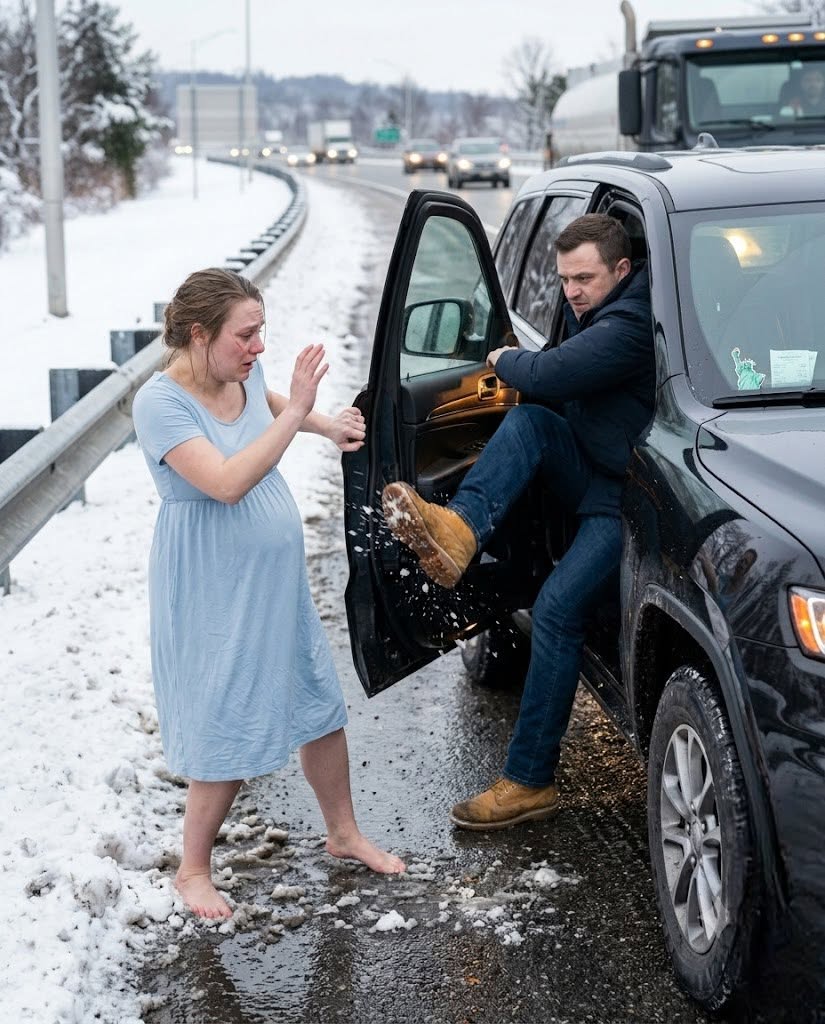
The first thing I felt was the cold asphalt through my dress.
The second was my husband’s shoe swinging back into the SUV as he slammed the passenger door inches from my hand.

Snow moved sideways across the shoulder outside Cedar Ridge, thin and mean, the kind that looked soft from a kitchen window and felt like needles when it hit bare skin.
The brand-new black SUV idled beside me with its heater still running.
My coat was on the back seat.
My phone was in my coat pocket.
Derek knew that when he looked down at me through the cracked passenger window.
“You’re bad luck,” he said.
I was eight months pregnant, barefoot, and shaking so hard I could hear my teeth clicking together.
The baby shifted under my ribs as if she already understood fear.
Derek tapped the steering wheel with two fingers, admiring it the way he admired anything new before he decided it had always belonged to him.
“I won’t let you ruin this car,” he sneered, “or my life.”
I stared at him through the blowing snow.
I said nothing.
That was always the part that made him angriest.
Derek could handle tears because tears made him feel powerful.
He could handle begging because begging let him decide whether he wanted to be merciful.
Silence gave him nothing to hold.
For months, he had told people I was fragile.
He said pregnancy had made me emotional.
He told his mother I picked fights.
He told his friends I was impossible to please.
He told the neighbors I had “episodes,” and he used that word with the tired patience of a man pretending to survive a woman who was actually surviving him.
Then he smiled from the driver’s seat.
“Walk home,” he said. “Maybe the baby will teach you not to embarrass me.”
The SUV pulled away so fast the back tire threw slush against my ankles.
For a moment, I did not move.
I stood under the gray sky with one hand beneath my belly and the other held close to my chest where the door had almost caught my fingers.
A tightening pain moved low through my body.
It rolled once, hard and slow.
I breathed through it because there was nobody there to breathe with me.
Headlights passed.
No one stopped.
A sedan swerved around me, horn blaring, and the driver never looked back.
The snow melted into my hair.
My dress stuck to my knees.
I tasted blood because I had bitten my lip hard enough to split it.
Still, I refused to cry on that shoulder.
Not there.
Not for him.
My daughter moved again beneath my ribs.
This time it felt less like fear and more like an order.
Survive now.
Punish later.
Never confuse mercy with surrender.
That sentence did not come from me.
It came from my grandmother.
She had said it the year before she died, sitting in her sunroom with a cup of tea beside her and a stack of estate papers in front of her.
She had always seen Derek more clearly than I wanted her to.
She never called him names.
She never raised her voice.
She simply watched him interrupt me, correct me, take credit for my work, and turn every little disagreement into a performance where he was the patient husband and I was the unreasonable wife.
One afternoon, after Derek left her house early because she refused to let him look through her financial files, she took my hand.
“Kindness is not the same as access,” she said.
I laughed then because I thought she was being dramatic.
I was not laughing on the side of that highway.
A truck finally slowed ahead of me.
Its hazard lights blinked through the snow.
The driver climbed down, a woman in a thick denim jacket and work boots, with graying hair tucked under a cap.
“My name is Rosa,” she called over the traffic. “Honey, are you hurt?”
I tried to answer, but my voice did not work right away.
Rosa crossed the shoulder fast, wrapped a blanket around me, and guided me toward the passenger side of her truck.
Her cab smelled like burnt coffee, vinyl, and peppermint gum.
A little Statue of Liberty magnet was stuck to the dashboard beside a stack of fuel receipts.
She turned the heat up until my feet stung.
“You want me to call the police?” she asked.
I watched Derek’s taillights disappear into the storm.
“Not yet,” I said.
Rosa looked at me for one long second, then nodded like she understood more than I had explained.
“Hospital first,” she said.
By the time we reached the emergency entrance, the tightening pain had come twice more.
Rosa parked crooked near the doors and helped me inside with one arm around my back.
The receptionist looked up and moved faster when she saw my bare feet.
A nurse put me in a wheelchair.
Another nurse asked me questions I answered in pieces.
Name.
Due date.
Pain level.
Fall or impact.
Unsafe at home.
I hated that last question because the answer had been growing for a long time, and somehow I still wanted to shrink it into something smaller.
The doctor confirmed the baby was safe.
Stress had triggered contractions, but her heartbeat was steady.
A monitor strap went around my belly.
The sound filled the room, quick and strong and bright.
I stared at the ceiling until my breathing matched it.
At 9:42 p.m., Derek texted me.
Don’t come home until you apologize.
I took a screenshot.
Then I saved it to two places.
Cruel men love witnesses when they think the witness belongs to them.
They forget that phones do not love anyone.
The nurse brought me socks and a cup of ice water.
Rosa stayed until she was sure I was admitted.
She left her number on a napkin because, as she put it, “men like that usually get louder before they get gone.”
I thanked her, and she squeezed my hand once before walking out.
When the room quieted, I opened the folder Naomi Chen had helped me prepare three weeks earlier.
Naomi was my lawyer.
She had started as my grandmother’s estate attorney, but after the funeral she became the person who looked me straight in the eye and asked questions no one else wanted to ask.
Did Derek have access to my accounts?
Had he ever taken my phone?
Had he ever threatened to make people think I was unstable?
Had he ever used the pregnancy as proof that I could not be trusted?
At the time, answering those questions felt humiliating.
Now it felt like a map.
The SUV had been purchased three days earlier with money from my late grandmother’s trust.
Derek’s name was not on the purchase agreement.
His name was not on the insurance.
His name was not on the title application.
He had gone with me to the dealership, smiled for the salesman, chosen the trim package, and called it “our upgrade,” but not one legal document gave him ownership.
That was the part he never cared to understand.
Derek believed marriage was a receipt.
If I had it, he could use it.
If I loved it, he could control it.
If I inherited it, he could explain why he deserved it more.
At 11:17 p.m., I called the dealership manager.
His name was printed on the purchase file, and my grandmother had taught me to keep every business card.
He answered on the fourth ring, sleepy and cautious.
I gave him the VIN.
I gave him the temporary tag number.
I gave him the purchase file reference.
Then I said, “At midnight, disable the vehicle’s digital access and flag it for unauthorized possession.”
There was silence.
Then paper moved.
“Mrs. Hayes,” he said, “are you safe?”
“For the first time tonight,” I said, “I’m getting there.”
After that, I called Naomi.
She picked up like she had been waiting.
“Where are you?”
“Hospital.”
“The baby?”
“Safe.”
“And Derek?”
“In my SUV.”
She exhaled slowly.
“Did he leave marks?”
“He left me barefoot on the highway in the snow.”
Naomi went quiet in a way that made me sit straighter.
Lawyers are trained to ask for facts before feelings, but sometimes facts are so ugly they become feelings all by themselves.
“Send me the text,” she said.
I sent the screenshot.
Then I sent the hospital intake note.
Then I sent a photo of my feet, red and swollen under the blanket.
Naomi replied with one sentence.
Do not warn him.
I knew what that meant.
The exit had to be secured before the confrontation.
The documents had to move before the story did.
The assets had to be protected before Derek realized he was not driving a prize.
He was driving evidence.
My final call went to Elias Grant.
Elias had worked for my grandmother for sixteen years, first as a security consultant after a break-in at one of her properties, then as the man she trusted whenever money and danger touched the same room.
He had a low voice, a calm mind, and the unsettling ability to make panic feel inefficient.
When I was nineteen, he taught me how to photograph a damaged lock.
When I was twenty-four, he taught me how to back up messages without changing metadata.
When I married Derek, he gave me a small safe for my documents and said, “Not because you expect trouble. Because adults prepare for reality.”
I had thought he was being old-fashioned.
Now his number was the only one I wanted to call.
His voice sharpened when I told him where Derek had left me.
“Do you want him frightened?” he asked.
I looked at the fetal monitor.
The heartbeat kept going.
Fast.
Bright.
Alive.
“No,” I said. “I want him certain he has won.”
Elias understood immediately.
“That gives us room,” he said.
At midnight, the SUV access went dead.
At 12:03 a.m., the dealership manager called back.
Derek had tried to restart the vehicle outside a gas station twenty miles away.
The app had locked him out.
The spare digital key had been revoked.
The vehicle location was pinned and recorded.
Derek called me seven times in four minutes.
I did not answer.
Then he texted.
What did you do?
Then another.
You psycho.
Then another.
Unlock my car.
My car.
I stared at those two words until they became almost funny.
Naomi called again while the texts kept arriving.
“He just texted your mother-in-law that you stole his car,” she said.
Of course he had.
Derek always built an audience before he built a lie.
His mother, Marlene, had spent years treating her son’s selfishness like a misunderstood leadership style.
When he forgot birthdays, he was busy.
When he spent money carelessly, he deserved nice things.
When he snapped at me in public, I had probably pushed him.
The first time I told her he had called me useless, she patted my hand and said, “Marriage is hard when men are under pressure.”
I never went to her again.
Naomi’s voice stayed even.
“Do you have the second trust letter?”
I froze.
Elias had asked the same question minutes earlier.
My grandmother had left two envelopes.
The first was the trust summary, clean and formal, the kind of document Derek skimmed with fake interest before asking whether the money was “available.”
The second was sealed, private, and addressed to me in my grandmother’s handwriting.
She made me promise not to open it unless Derek ever put me or the baby in danger.
I had kept it in the small safe Elias gave me.
But I did not have it at the hospital.
“I don’t,” I said.
Naomi paused.
“Elias does,” she said.
Five minutes later, a nurse came in carrying a sealed envelope from the front desk.
Rosa stood near the doorway with her blanket folded over her arm, waiting for her ride back to the truck stop.
When she saw my face, she covered her mouth.
The envelope had my name on it.
Not typed.
Written.
My grandmother’s handwriting moved across the paper in the same firm slant I had seen on birthday cards, grocery lists, and the note she once taped to my fridge after Derek complained my apartment looked “too single.”
Keep the plants. Lose the man if necessary.
I broke the seal with shaking hands.
Inside was a letter and a copy of a trust amendment.
The first sentence began with Derek’s full legal name.
If Derek Michael Hayes ever attempts to coerce, isolate, threaten, abandon, or financially exploit my granddaughter during pregnancy or after the birth of her child…
I stopped reading because the room tilted.
Naomi was still on speaker.
“Keep going,” she said gently.
I read the next line.
The amendment directed immediate separation of all remaining trust distributions from any marital access claim, authorized emergency legal protection, and funded independent housing, medical support, and security for me and the baby.
My grandmother had not just suspected Derek.
She had prepared for him.
I cried then.
Not loudly.
Not beautifully.
Just one hand over my mouth while the monitor kept recording my daughter’s heartbeat and Rosa turned toward the window to give me privacy.
Then Derek called again.
This time I answered.
His voice exploded through the phone.
“You think this is cute?” he shouted. “You stranded me.”
I looked down at my bare feet under the hospital blanket.
“Stranded you?” I said.
“You need to unlock the SUV right now.”
“No.”
It was such a small word.
It felt like a door.
There was a pause on his end.
Derek was not used to hearing me say no without softening it.
“You’re going to regret this,” he said.
“I already regretted a lot of things tonight.”
“You’re unstable. Everyone knows it. I’m calling my mother. I’m calling the police. I’m telling them you stole from me.”
“Do that,” I said.
Naomi did not interrupt.
Elias did not speak.
The room held still.
Derek laughed once, sharp and fake.
“You’re nothing without me.”
That was the old line.
The one he used whenever I remembered I had a bank account, a family history, a name before his, or a spine.
But it sounded different now.
It sounded like a man yelling from inside a locked vehicle that did not belong to him.
“No,” I said. “I was quiet without you. That’s not the same thing.”
He cursed.
Then the line clicked dead.
At 12:28 a.m., Naomi filed the emergency paperwork.
At 12:41 a.m., Elias confirmed that the SUV’s location record, Derek’s calls, and his texts had been preserved.
At 1:06 a.m., Marlene texted me.
How dare you humiliate my son.
I looked at that message for a long time.
Then I took another screenshot.
By morning, Derek had turned the story into a performance.
He told his mother I had a breakdown.
He told his friends I abandoned him at a gas station.
He told our neighbor I was trying to punish him because he would not let me “control everything.”
What he did not know was that Naomi had already sent the dealership documents, the hospital notes, the text thread, the vehicle location record, and the trust amendment into one clean file.
Facts do not need volume.
They just need order.
That afternoon, Marlene came to the hospital.
She wore her church coat and the hard little smile she used when she wanted nurses to think she was respectable.
Derek was behind her, pale and furious, with snow salt still dried at the cuffs of his jeans.
He looked at me in the hospital bed and then at my belly.
For half a second, I saw him calculate what expression would work best.
Concern.
Victimhood.
Control.
He chose concern because there were witnesses.
“Baby,” he said softly, “you scared everyone.”
Marlene sighed beside him.
“You need to stop this before people get the wrong idea.”
Naomi arrived before I could answer.
She stepped into the room with a folder under one arm and looked at Derek like he was a typo she was about to correct.
“This conversation is being documented,” she said.
Derek’s face tightened.
Marlene blinked.
Naomi placed the first page on the rolling tray beside my bed.
It was the purchase agreement.
Then the title application.
Then the insurance binder.
Then the hospital intake note.
Then Derek’s text telling me not to come home until I apologized.
Marlene’s eyes moved faster with every page.
Derek tried to laugh.
“That proves nothing.”
Naomi placed the trust amendment on top.
The room changed.
It was not dramatic.
No thunder.
No shouting.
Just Derek reading his own full legal name in my grandmother’s letter and realizing that an elderly woman he had dismissed as sentimental had seen him coming from years away.
Marlene whispered, “Derek.”
He did not look at her.
He was staring at the line that authorized immediate legal separation of assets if he endangered me during pregnancy.
I watched his confidence drain out of his face like water.
For months, he had convinced people I was fragile, emotional, unstable.
On paper, in black ink, he was the risk.
The dealership recovered the SUV that afternoon.
Derek did call the police, but not with the story he expected to tell.
Once the documents were reviewed and the title issue was clear, his complaint turned into questions he did not want to answer.
Why was he in possession of a vehicle registered to me?
Why had he left his pregnant wife barefoot on a highway?
Why had he sent texts that matched her account almost word for word?
He had built an audience for his lie.
He had not planned for a record.
I did not go back to the house.
Elias arranged for my safe, my documents, my grandmother’s jewelry, and the baby’s things to be removed while Derek was still trying to convince people he was the victim.
Naomi handled the legal filings.
Rosa came by the hospital once more with a paper coffee cup and a pair of fuzzy socks she said she bought at a gas station because “hospital floors are no place for a woman rebuilding her life.”
I wore them the day my daughter was born.
Derek was not in the room.
My daughter came into the world with a cry so fierce the nurse laughed.
I cried too, but that time there was no shame in it.
Only relief.
Only exhaustion.
Only the strange, bright terror of holding someone who would never have to learn love from a man who confused ownership with care.
Weeks later, when the formal separation was underway, Derek sent one final message from a new number.
You destroyed my life.
I looked at my sleeping daughter, wrapped in a yellow blanket beside the window.
Then I typed back one sentence.
No, Derek. I stopped letting you use mine.
I blocked the number after that.
People asked me later why I waited so long to act.
They asked why I did not scream on the highway.
Why I did not chase the SUV.
Why I said “not yet” when Rosa asked about the police.
The truth is simple.
I had spent months being called fragile by a man who depended on my silence.
But silence was never weakness.
Silence was how I listened.
Silence was how I learned.
And that night, while Derek drove away certain he had won, silence was how I heard the last piece click into place.